
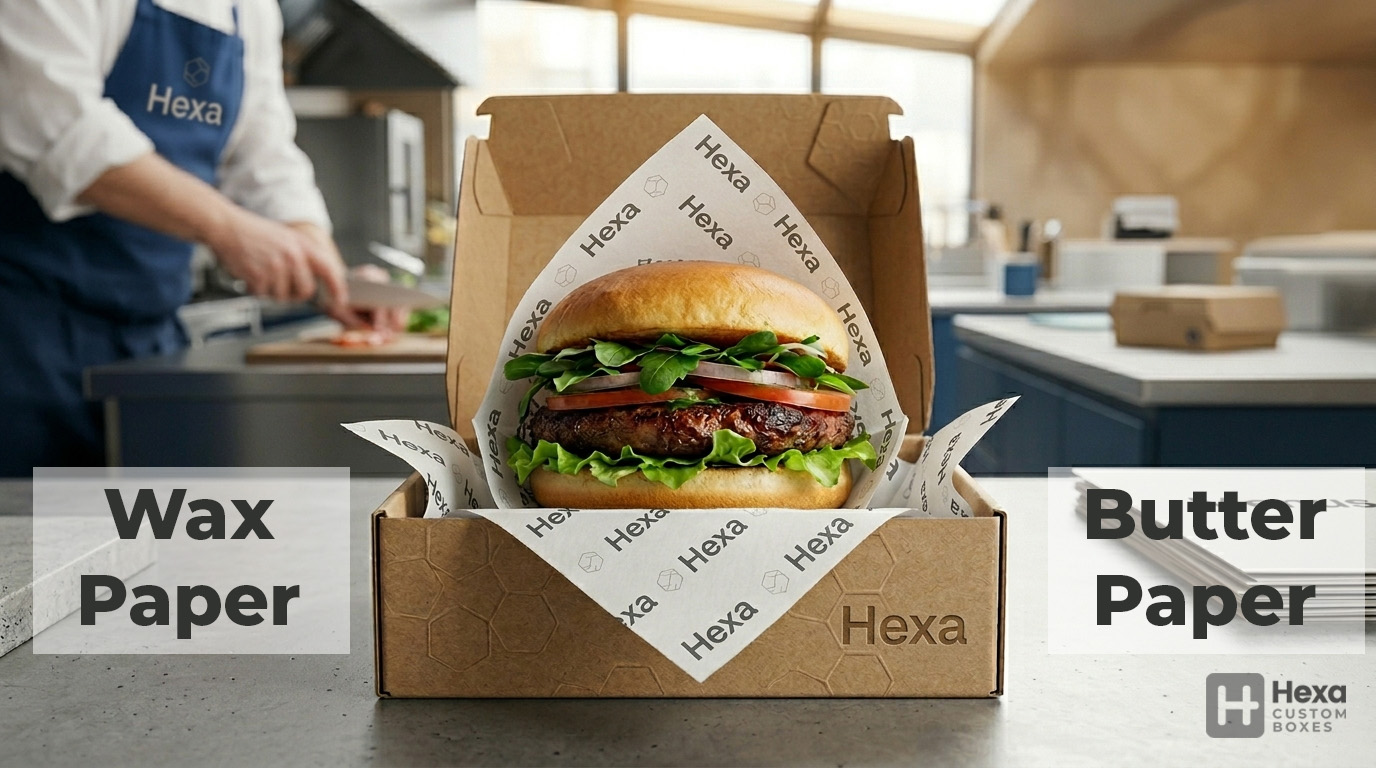
In the food business, your packaging is your silent salesperson. Before a customer even takes their first bite, they interact with the materials you’ve chosen to protect, wrap, or serve your product. For brand owners, the decision between Wax Paper and Butter Paper (Greaseproof) is often treated as a minor procurement task, but it is actually a critical strategic choice.
In This Guide:
- At a Glance: The Decision Matrix
- Technical “Must-Knows” (Problems & Solutions)
- When to Choose Wax Paper
- When to Choose Butter Paper
- The Hexa Branding Advantage
- Frequently Asked Questions (FAQs)
I. Introduction: The Packaging Choice That Impacts Sales
In the food business, your packaging is your silent salesperson. Before a customer even takes their first bite, they interact with the materials you’ve chosen to protect, wrap, or serve your product. For brand owners, the decision between Wax Paper and Butter Paper (Greaseproof) is often treated as a minor procurement task, but it is actually a critical strategic choice.
The Brand Owner’s Dilemma
Choosing the wrong paper isn’t just a technical oversight—it’s a direct hit to your professional reputation. We have all experienced the “Packaging Failure”: a delicious burger arriving in a box stained with unsightly grease spots, or a fresh bakery item turning soggy because the wrapper trapped too much moisture.
When your packaging fails to perform, the customer’s perception of your brand shifts instantly from “premium” to “messy.” Whether you are a local cafe, an e-commerce food brand, or a high-volume catering service, your choice of paper directly dictates:
- Food Integrity: How your product looks and tastes when it finally reaches the customer.
- Professional Perception: Whether your unboxing experience feels curated or haphazard.
- Operational Waste: The cost of replacing damaged packaging or dealing with customer complaints.
At Hexa Custom Boxes, we believe that packaging is an ecosystem where function meets brand identity. This guide is designed to solve your dilemma by cutting through the technical jargon. We’ll show you exactly how to match the right material to your specific product, ensuring your food stays fresh and your brand stays spotless—every single time.
II. At a Glance: The Quick Decision Matrix
If you need a quick answer to make an immediate packaging decision, look no further. This table breaks down the core differences between Wax Paper and Butter (Greaseproof) Paper so you can select the right material based on your product’s specific needs.
| Feature | Wax Paper | Butter/Greaseproof Paper |
| Best For | Cold/Moist foods | Hot/Fried foods |
| Heat Tolerance | Low (Fire Hazard) | Moderate/High |
| Grease Resistance | Low | High |
| Brand Clarity | Moderate | High (Better for ink) |
How to read this matrix:
- The “Hot vs. Cold” Rule: If you are serving anything heated, Butter (Greaseproof) Paper is your only safe option. Wax paper is coated in paraffin, which will melt or potentially ignite under high heat.
- The “Grease Factor”: If your menu features fried chicken, fries, or oily pastries, Butter Paper acts as an effective grease barrier, keeping your outer custom boxes pristine and grease-free.
- The “Branding” Factor: Because Butter Paper is mechanically denser and lacks a wax coating, it typically offers a sharper, higher-resolution surface for your custom brand logos and messaging.
Hexa Pro-Tip: Don’t let your packaging dictate your menu. Match your packaging to your food to ensure that the quality of your product matches the quality of your brand presentation.
III. The Technical “Must-Knows” (Problems & Solutions)
Understanding the properties of your packaging materials is the difference between a satisfied customer and a messy, avoidable complaint. Here is how to navigate the most common technical pitfalls.
1. The Heat Problem: Safety First
- The Problem: Many brand owners mistakenly use wax paper for hot foods or in ovens. Because wax paper is coated with paraffin wax, it has a low melting point. High temperatures can cause the wax to melt into your food or, in extreme cases, act as a fire hazard.
- The Solution: Use Butter/Greaseproof Paper for anything that is served hot. It is designed to withstand higher temperatures, making it the only safe choice for hot food wrapping and baking applications.
2. The Moisture Problem: Soggy vs. Fresh
- The Problem: Using the wrong barrier for moist goods leads to a “soggy sandwich” effect. If you wrap a piping-hot, crispy fried item in a material that traps steam, the item will lose its crunch before it reaches the customer.
- The Solution: Butter/Greaseproof Paper is naturally “breathable” yet grease-resistant. It allows a minimal amount of steam to escape while preventing oil from soaking through, keeping your fried goods crispy and your presentation clean.
3. The Printability Problem: Branding Integrity
- The Problem: Wax paper’s surface is slick and non-porous, which can cause ink to smudge, smear, or fade, making your logo look cheap or unprofessional.
- The Solution: Butter/Greaseproof Paper offers a more stable, fiber-dense surface. At Hexa Custom Boxes, we recommend this material for any custom-printed project because it holds ink sharper and clearer, ensuring your brand identity remains vibrant and readable.
Hexa Pro-Tip: Never prioritize cost savings over material integrity. An extra cent spent on the correct paper is a direct investment in the repeat business of your customer.
IV. When to Choose Wax Paper (Use-Case Solutions)
Wax paper is an excellent, cost-effective tool when your product requires moisture retention rather than heat resistance.
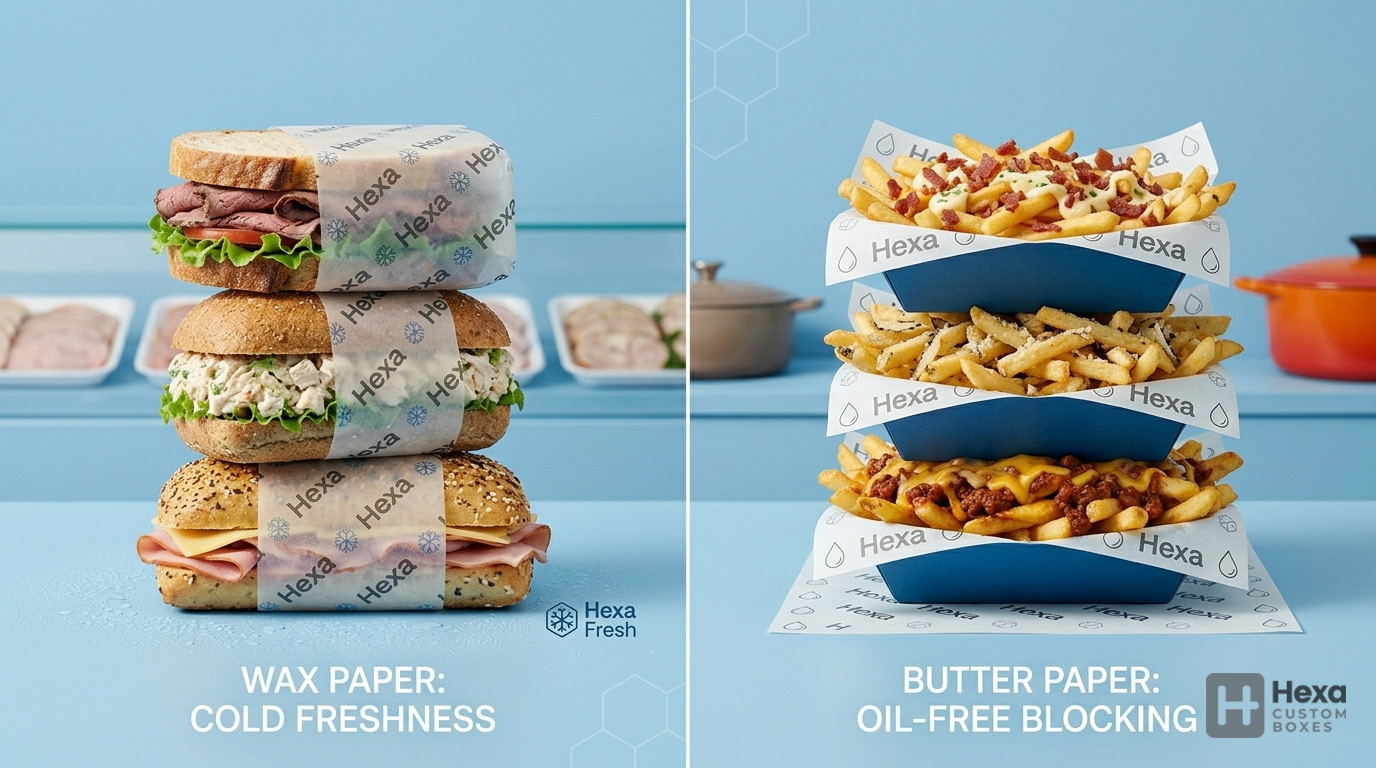
- Problem: Keeping Cold Items Fresh. * Scenario: You run a deli or a cafe serving cold sandwiches, chilled salads, or refrigerated snacks.
- The Solution: Wax paper acts as a superior moisture barrier. It seals in the natural humidity of cold products, preventing them from drying out while they sit in a display case. It is ideal for short-term cold storage where you need a quick, non-stick wrap that doesn’t need to be heated.
| Product Type | Why Wax Paper? | Performance Goal |
| Deli Sandwiches | Seals in natural moisture | Prevents bread from drying out |
| Cold Salads | Non-stick surface | Keeps ingredients crisp |
| Chilled Confectionery | Creates a moisture barrier | Keeps chocolates from “sweating” |
Hexa Tip: Use wax paper for items that are pre-packed for grab-and-go convenience in a refrigerated display. It’s perfect for maintaining the texture of cold deli meats and cheese.
V. When to Choose Butter Paper (Use-Case Solutions)
Butter (Greaseproof) Paper is the professional standard for hot food service. It is engineered to handle heat and oil without compromising your brand’s aesthetic.
- Problem: Eliminating Oily Stains on Packaging.
- Scenario: Your menu features fried chicken, loaded fries, hot paninis, or buttery pastries. These products naturally release oils that can soak through standard paper.
- The Solution: Butter paper is mechanically dense, creating an effective grease barrier. By using it as a primary wrap inside your custom boxes, you ensure that the oils stay inside the wrapper, keeping your outer packaging dry, clean, and professional.
- Problem: Maintaining “Crunch.”
- Scenario: Your customers expect their fried food to arrive crispy, not steamed and soggy.
- The Solution: Unlike wax paper, greaseproof paper balances moisture control with a slight “breathability,” ensuring that excess steam escapes so your food retains its desired texture.
| Product Type | Why Butter Paper? | Performance Goal |
| Fried/Hot Foods | High-density grease barrier | Prevents oil stains on boxes |
| Hot Paninis | Breathable heat management | Prevents steam-induced sogginess |
| Buttery Pastries | Clean, non-stick handling | Keeps customers’ hands oil-free |
Hexa Tip: For any product coming off a grill or out of a fryer, butter paper is the only way to ensure the unboxing experience is as appetizing as the food itself.
VI. The Hexa Branding Advantage: Why “Generic” Hurts You
In a crowded market, your packaging is your billboard. Using generic, unbranded paper is a missed opportunity to reinforce your identity. At Hexa Custom Boxes, we transform functional food paper into a high-impact marketing asset.
Why Custom Branding Matters
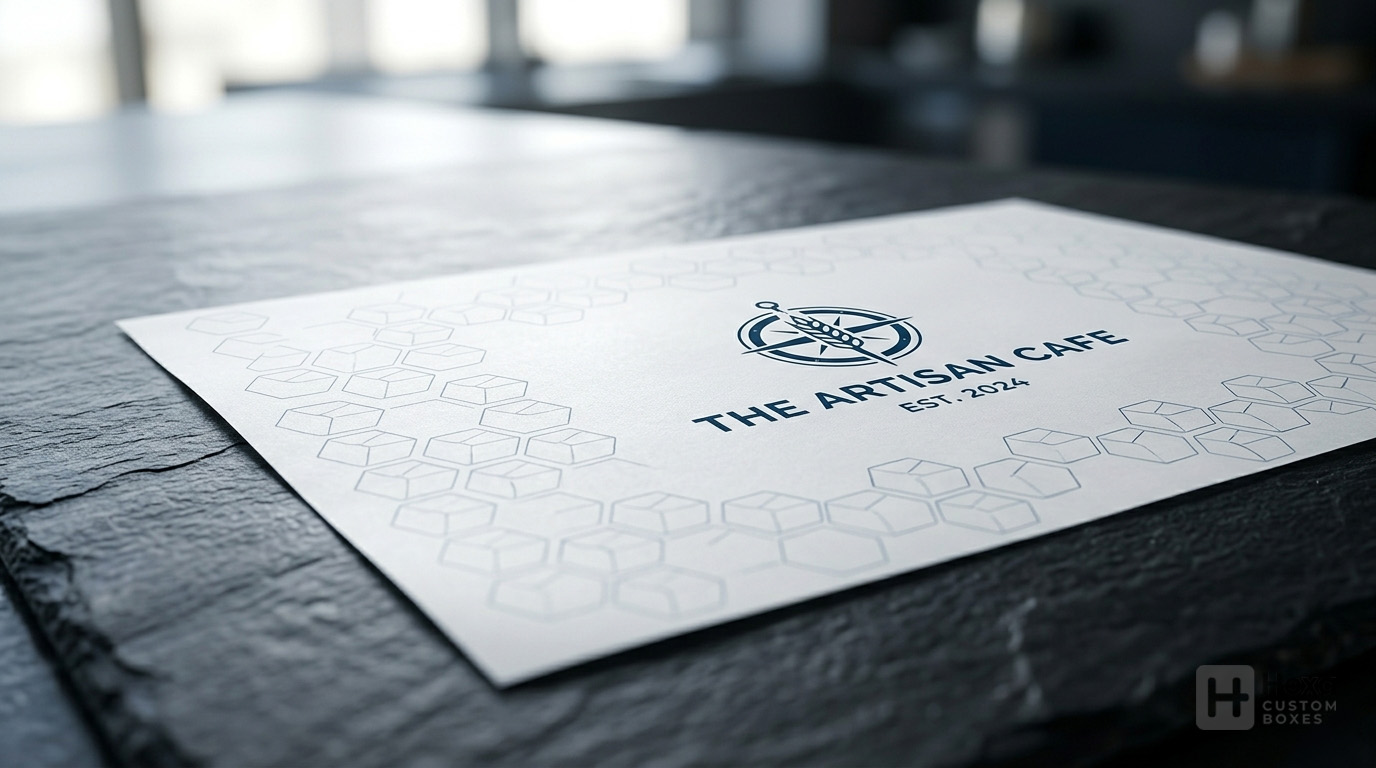
- Elevated Perception: Custom-printed butter paper signals to your customer that your brand cares about every detail—down to the wrapper. It turns a standard meal into a “branded experience.”
- Consistent Brand Voice: Your logo, social media handles, or brand story printed on your paper creates a cohesive aesthetic that spans from the custom box down to the last bite.
- Customer Trust: Professional, high-quality printing communicates that you use food-safe, premium materials, which reinforces trust in your brand’s overall quality.
The Hexa Quality Promise
When you choose to brand your paper with us, you aren’t just getting a logo on a sheet, you are getting a partnership built on:
- Food-Safe Inks: We prioritize your customers’ health, utilizing only certified food-grade printing processes that remain vibrant without compromising safety.
- Precision Printing: Our technology ensures your branding remains crisp and readable, even when the paper is wrapped around warm, greasy foods.
- Material Integrity: We pair your custom print with the exact GSM and coating (Wax vs. Butter) your food requires, so your branding never compromises the product’s taste or texture.
VII. Frequently Asked Questions (FAQs)
Q: Can I use butter paper in the microwave?
A: Yes, most high-quality, greaseproof paper is microwave-safe. Always ensure you are using food-grade materials for the best safety results.
Q: Does custom printing on food paper affect food safety?
A: Not if done correctly. At Hexa Custom Boxes, we exclusively use food-grade, certified safe inks for direct food contact.
Q: Which paper is more eco-friendly?
A: Greaseproof (butter) paper is often easier to recycle because it lacks the paraffin wax coating that can contaminate recycling streams.
Q: Can I use wax paper as a cheaper alternative for my bakery?
A: We advise against it for baked goods. Wax paper can melt in the oven and lacks the non-stick properties of professional greaseproof paper.
Q: What is the minimum order quantity (MOQ) for custom-printed paper?
A: We scale for brands of all sizes. Please contact our sales team to discuss your specific needs.
Final Recommendation
The decision is simpler than it seems. Don’t let your packaging strategy become an afterthought—it’s the final impression you leave on your customer.
The “Hexa” Rule of Thumb
“If it’s hot, go Greaseproof. If it’s cold, go Wax.”
Your Next Step
Your brand’s reputation is wrapped in every package you send out. Make sure it reflects the quality you put into your food.
Ready to upgrade your food packaging?