
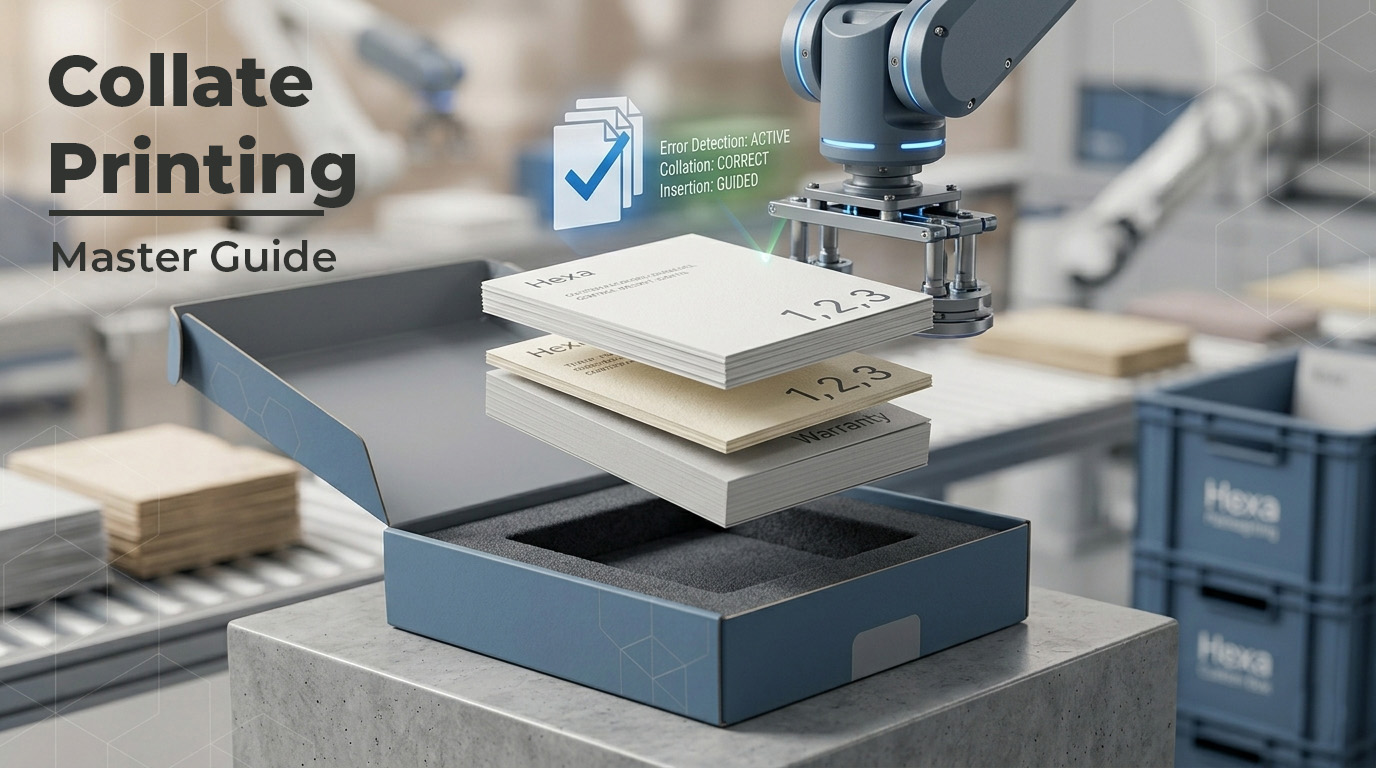
I. Introduction: The Critical Role of Collate Printing in Packaging Excellence
In the precision-driven world of modern manufacturing and e-commerce, the difference between a high-end brand experience and a logistical nightmare often lies in the details that arrive inside the box. Whether you are shipping premium electronics, artisanal cosmetics, or subscription-based lifestyle products, your packaging is more than just a protective shell, it is the final touchpoint of your customer’s journey. At the heart of a seamless, professional unboxing experience sits a fundamental, yet often misunderstood, printing workflow: Collate Printing.
Defining Collate Printing: The “Sequential Advantage”
At its simplest level, collating is the process of gathering and arranging individual pages or sheets of printed material into a specific, predetermined order.
Imagine you are printing a 4-page instruction manual for a new kitchen appliance. Without collation, the printing process would produce thousands of “Page 1” sheets, followed by thousands of “Page 2” sheets, and so on. Your team would then be forced to manually gather and sort these piles to create complete manuals.
Collate printing automates this. The printer organizes the pages in the correct sequence—Page 1, Page 2, Page 3, Page 4—so that when the sheets exit the machine, they are already grouped as finished, ready-to-use sets. It is the transition from “raw printouts” to “ready-to-distribute documents.”
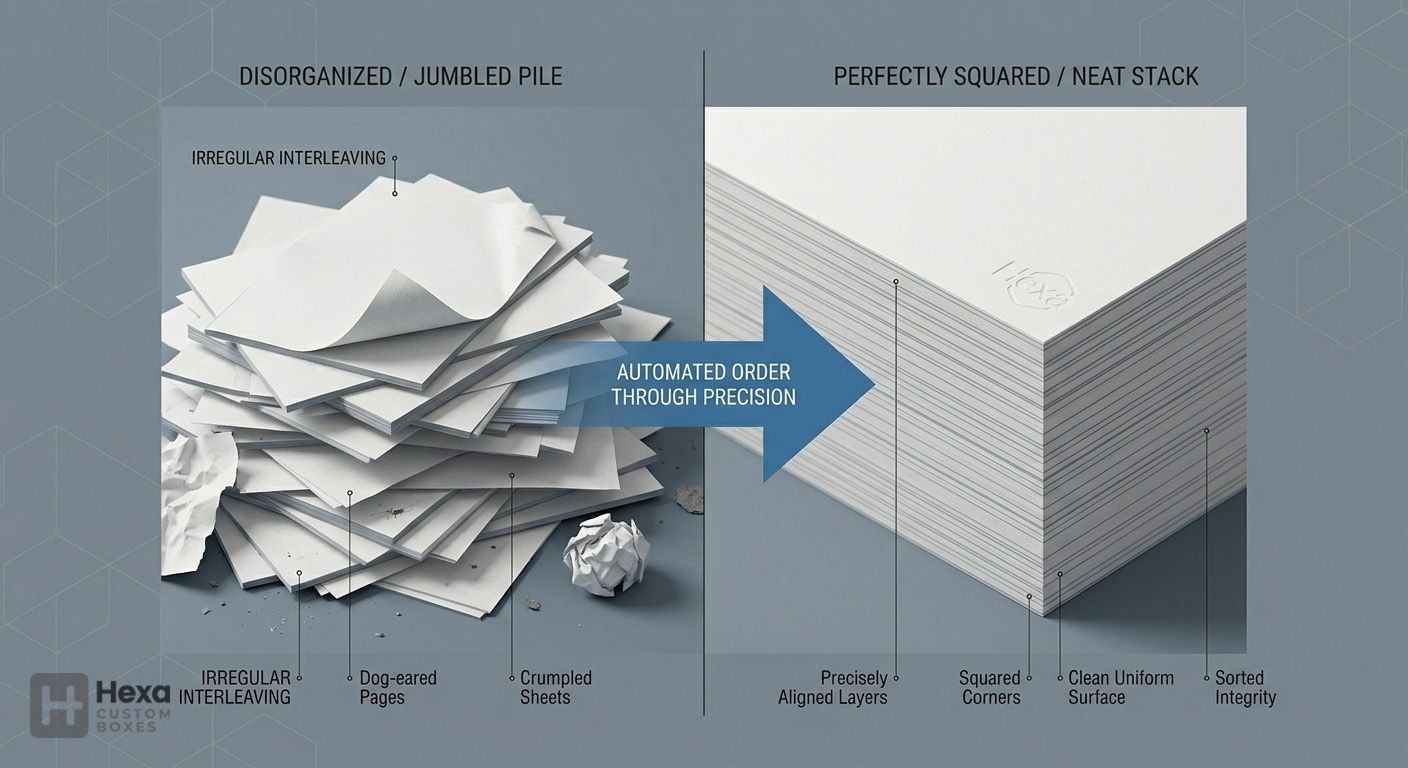
Why It Matters: From Sorting Headaches to Operational Efficiency
For business owners and packaging managers, understanding collation is about shifting your perspective from merely “printing paper” to “optimizing assembly.” At Hexa Custom Boxes, we view collation as a critical pillar of packaging integrity. Here is why this distinction is vital:
- Eliminating the “Human Factor” in Assembly
When your packaging involves multiple inserts—such as a warranty card, a branded thank-you note, a multi-language user manual, and a promotional flyer—the complexity of assembly increases exponentially. If these components are delivered uncollated, your fulfillment staff must manually sort, stack, and verify every single set. This is not only a massive drain on labor hours but also an invitation to error. A missing page or a misplaced instruction booklet can lead to customer frustration and product returns. Collated printing guarantees that every set inside your box is complete and in the correct order, effectively “error-proofing” your assembly line.
- Protecting Your Brand’s Premium Perception
Unboxing is a psychological event. When a customer opens a box, they expect a cohesive, curated experience. If they find a stack of papers that feel disorganized or—worse—receive the wrong insert, that “premium” feeling evaporates instantly. Collation ensures that every single box that leaves your facility feels intentional and high-end. It signals to your customer that your brand pays attention to the small things, building trust and reinforcing your commitment to quality.
- Streamlining the Supply Chain
For high-volume retail or e-commerce operations, time is the most expensive variable. By utilizing collated printing services, you integrate the “sorting” phase of your workflow directly into the printing phase. This allows your production team to shift their focus from administrative sorting to high-value tasks like packing, quality assurance, and shipping. When your inserts arrive ready-to-place, you slash your packaging cycle time, enabling you to move more products through your facility in the same amount of time.
The Hexa Custom Boxes Perspective
At Hexa Custom Boxes, we believe that packaging is an ecosystem. Printing a box is only half the battle, ensuring that what goes inside the box is just as professional as the container itself is what sets market leaders apart. We don’t just treat printing as a commodity, we treat it as an engineering challenge.
By prioritizing collate printing in your packaging strategy, you aren’t just ordering paper inserts—you are investing in a system that reduces overhead, prevents costly errors, and ensures that every customer who opens your package is met with the same level of precision and professionalism. In the following sections of this master guide, we will dive deeper into the technical mechanics of the process, the hardware requirements, and the strategic decisions that will help you leverage collation to take your packaging operations to the next level.
II. The Fundamentals: Collate vs. Uncollated
Understanding the technical distinction between “collated” and “uncollated” printing is the first step toward optimizing your assembly workflow. At Hexa Custom Boxes, we often see businesses default to one method without considering the downstream impact on their labor costs and packaging speed. Choosing the right method isn’t just about printing, it’s about engineering the physical flow of your product components.
Visualizing the Difference
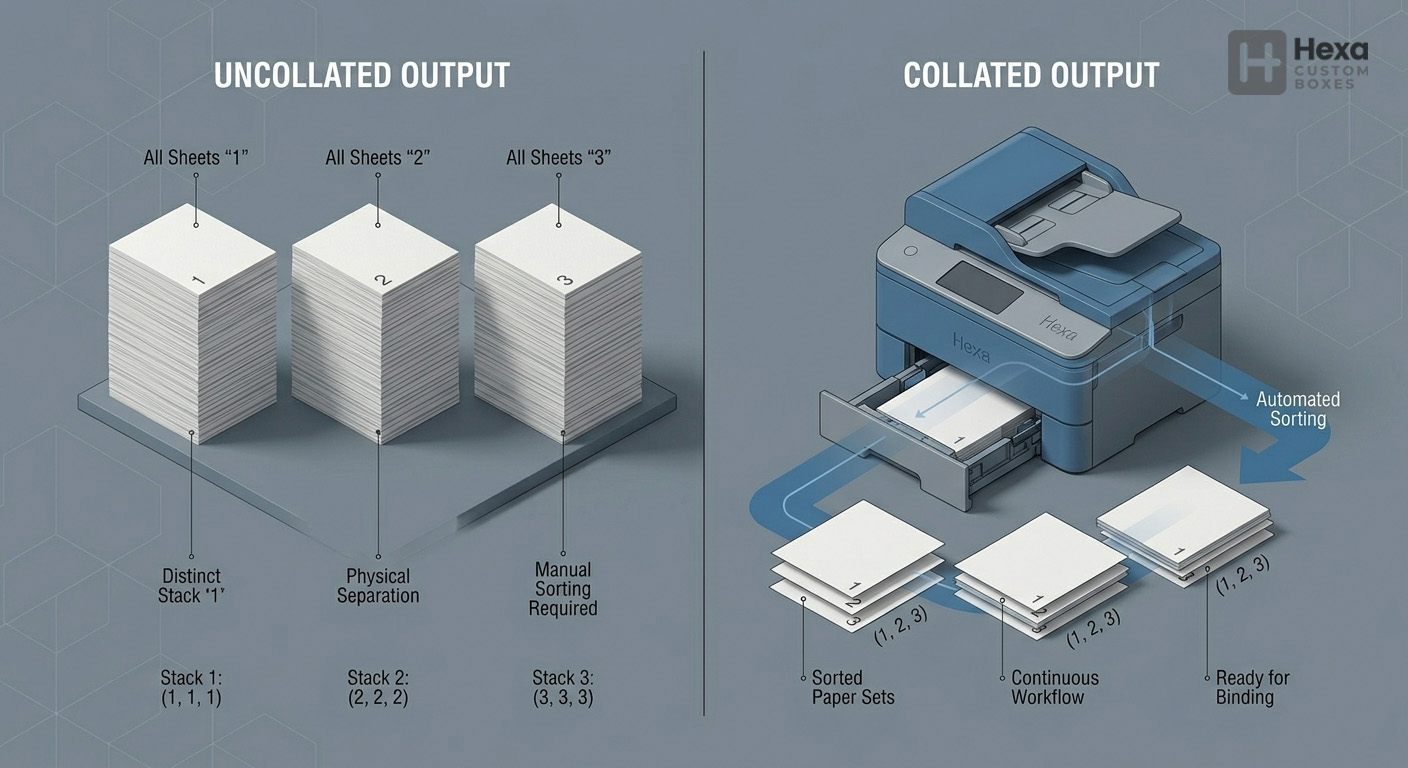
To grasp the operational impact, visualize the output of a high-speed printing press for a 3-page instruction manual:
- Uncollated Printing (The “Stacked” Method): The press prints all copies of “Page 1,” then all copies of “Page 2,” and finally all copies of “Page 3.” Your output is essentially three distinct piles.
- Sequence: 1, 1, 1, 1… / 2, 2, 2, 2… / 3, 3, 3, 3…
- Result: To create a single manual, your staff must manually pull one from each stack, increasing the risk of missing pages, duplicate sheets, or inverted sequences.
- Collated Printing (The “Sequential” Method): The press (often assisted by a multi-bin sorter or inline finishing equipment) outputs the pages in their final reading order. Every time a set exits the machine, it is already “1, 2, 3.”
- Sequence: 1, 2, 3, 1, 2, 3, 1, 2, 3…
- Result: Each set is ready for immediate insertion into your custom box. This eliminates the need for manual pre-sorting entirely.
When to Use Collated Printing: Multi-Page Complexity
Collated printing is the gold standard for any component that requires the end-user to read pages in a specific order.
- Multi-Page Instruction Manuals: For electronics or assembly-required products, order is non-negotiable. If a user receives an instruction booklet where page 1 is followed by page 3, they will likely assume the product is defective or the brand is unprofessional.
- Warranty Booklets & Policy Docs: If you have a multi-part legal or policy document included in your packaging, collation ensures that page numbering remains consistent, which is crucial for legal compliance.
- Complex “Welcome” Packs: If your brand includes a multi-page welcome experience (e.g., a “How to start” guide + “Brand Story” + “Community Info”), collation keeps these components in their intentional order, ensuring the customer journey unfolds exactly as your marketing team designed.
When to Use Uncollated Printing: Efficiency & Economy
Uncollated printing is not “inferior”, it is a strategic choice for high-volume, single-component scenarios.
- Single-Page Inserts: If you are printing a one-page “Thank You” card, a single-sided flyer, or a promotional coupon, there is no sequence to maintain. Printing these uncollated is often faster and more cost-effective because the press doesn’t need to engage its sorting mechanisms or pause between different page data.
- High-Volume Bulk Distribution: If you have separate stacks of different items—for example, a large pile of “Thank You” cards and a separate large pile of “Technical Spec” sheets—and your assembly line uses an automated “kitting” machine that draws from different hoppers, uncollated is the standard. In this scenario, the machine does the “collating” by pulling one item from each dedicated hopper, so the printing stage doesn’t need to perform that function.
- Variable Batching: If you are managing inventory for different product tiers and you need to keep your print materials strictly segregated by SKU, printing uncollated allows you to control the exact inventory count of each sheet type before they are moved to the packing floor.
The Bottom Line for Packaging Managers
The rule of thumb is simple: If the item needs to be “ready-to-insert,” choose collation. If the item is a standalone component that will be integrated with other components later, or if it is a single-page document, uncollated printing will likely save you on setup and production time.
At Hexa Custom Boxes, we evaluate every project’s assembly process to determine which method will save you the most time on the floor. By identifying these needs early, we help our partners avoid the “sorting bottleneck”—the hidden labor cost that eats into margins—and ensure that your packaging line remains as streamlined as possible.
III. The “Hexa Advantage”: Why Precision Matters in Packaging
At Hexa Custom Boxes, we don’t view printing as a separate phase from packaging production. Instead, we treat the two as a singular, synchronized ecosystem. Integrating collation into our workflow isn’t just about printing pages—it’s about engineering your assembly process for maximum throughput. When your business chooses to partner with a team that understands the technical demands of both paper science and packaging structural integrity, you move from “purchasing supplies” to “optimizing operations.”
Integrating Collation into the Hexa Workflow
Our internal workflow is built around the “ready-to-insert” philosophy. We utilize high-speed digital and offset printing lines equipped with advanced, inline finishing and sheet-fed collating units. Here is how we ensure that your materials arrive at your facility in the exact state you need them:
- Synchronized Data Management: We don’t just print, we manage the sequence. Our systems are programmed to cross-reference your specific assembly needs against our print runs. Whether it is a 12-page multilingual user manual or a 3-part marketing collateral set, we ensure the variable data and page sequences are perfectly aligned at the press level.
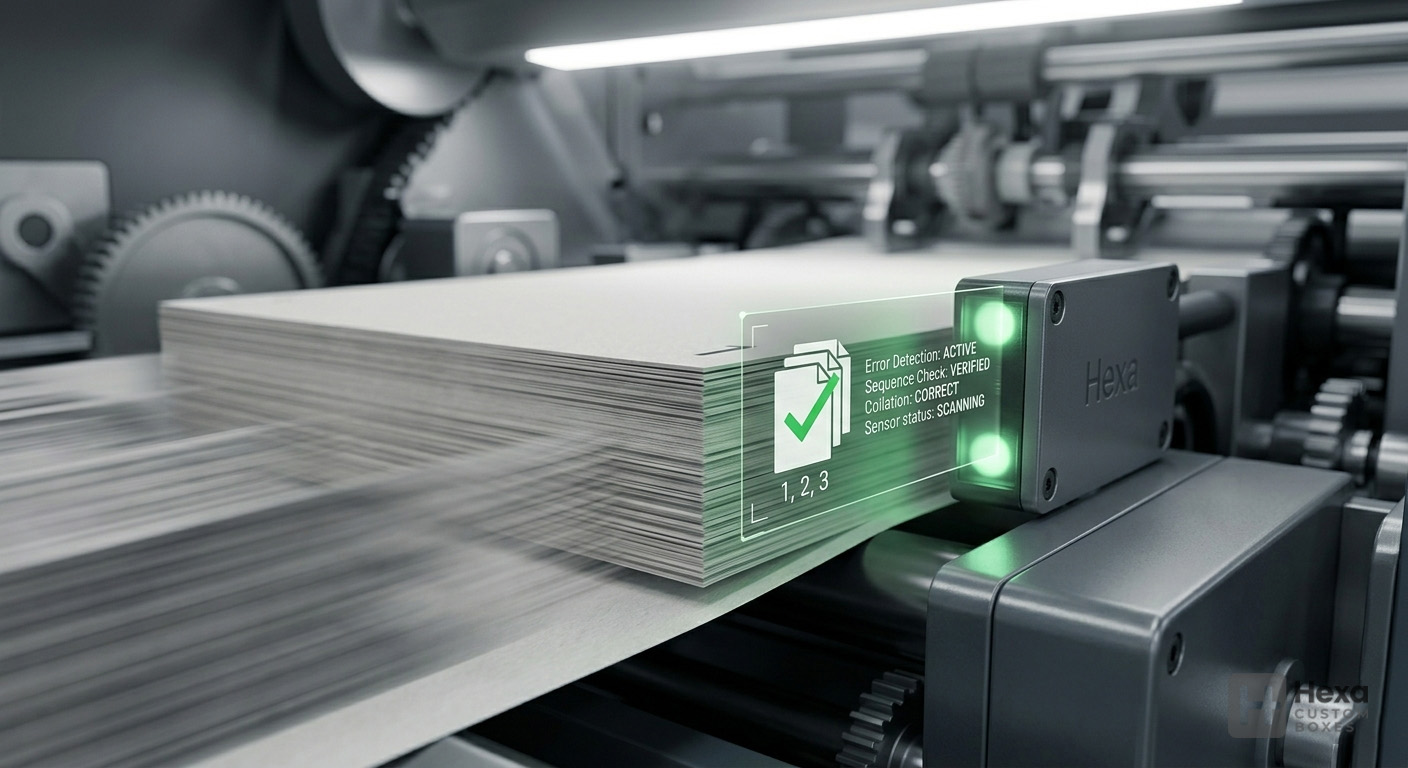
- Inline Finishing & Verification: We utilize integrated sensors and “mark-sensing” technology during the collating process. These sensors detect page order and count in real-time. If a single page is missing or misaligned, the system flags the error instantly, ensuring that you never receive an incomplete set.
- Structural Compatibility: We understand that the thickness of your printed inserts matters. A collated stack of 100gsm art paper has different physical characteristics than 150gsm cardstock. We calibrate our equipment to handle your specific paper GSM (Grams per Square Meter) to ensure that the collation is precise and that the stacks are perfectly squared for seamless handling on your end.
The Quantifiable Impact on Your Production Lines
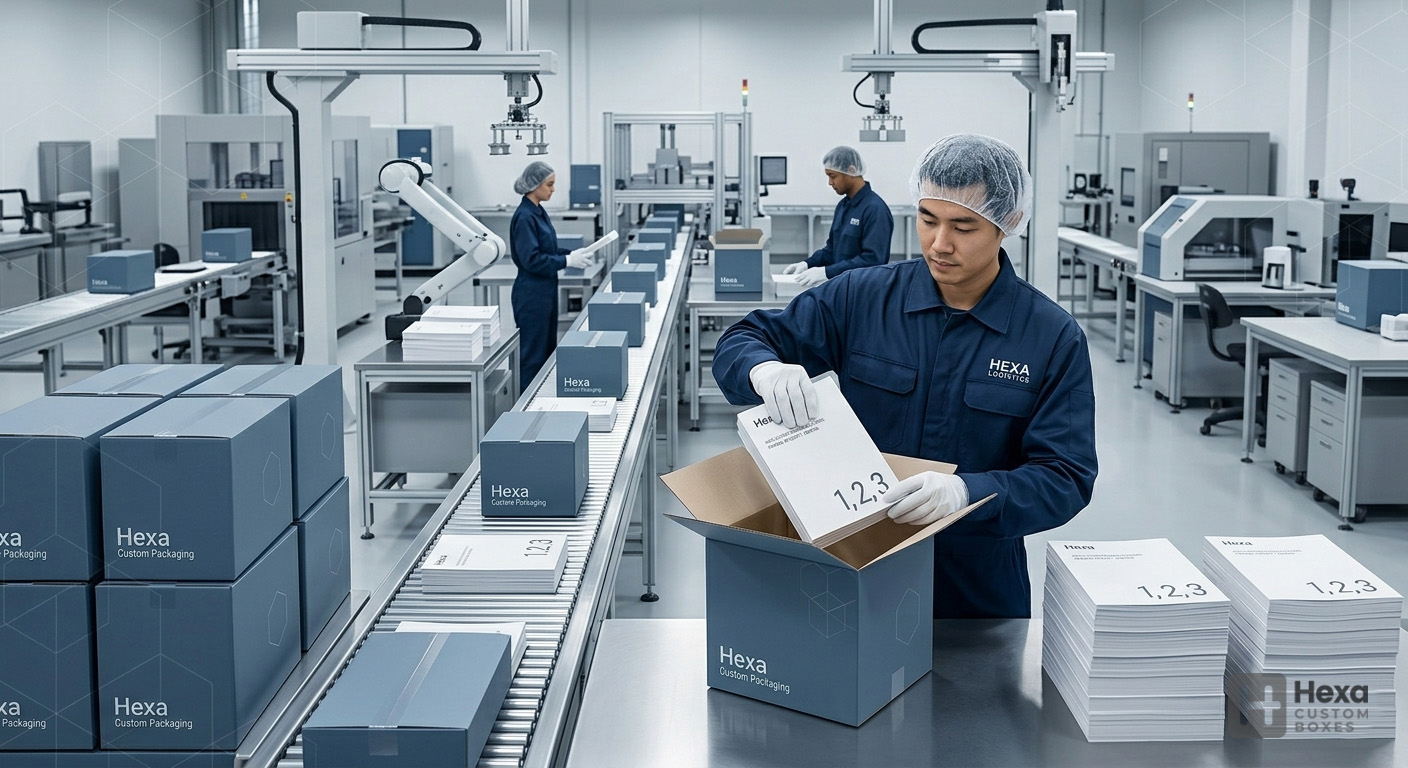
For most of our B2B partners, the “hidden” cost of packaging is the labor required to prepare components for insertion. By leveraging Hexa’s precision-collated prints, you effectively outsource the most tedious portion of your assembly line to us.
- Reduction in “Non-Value-Added” Labor: In a standard, non-collated workflow, your staff may spend hours each day manually sorting and stacking inserts. By receiving pre-collated sets, this manual step is eliminated. You move directly from “receive” to “insert,” allowing your team to focus on the higher-value aspects of assembly, such as quality control, product placement, and sealing.
- Minimized Assembly Errors: The most common source of “customer complaints” in e-commerce is the missing manual or the incorrect insert. By automating the collation process, we virtually eliminate human error. Every box that your team fills will contain exactly what it needs, in the correct order, every single time.
- Increased Throughput: When every component arrives ready-to-use, your assembly line speed increases significantly. You can forecast your production capacity with greater confidence, knowing that your kitting process won’t be held up by a “sorting bottleneck.”
Why Precision is a Strategic Asset
When we talk about “The Hexa Advantage,” we are talking about Operational Predictability. We know that for a business owner, the goal is to have an assembly line that runs smoothly, reliably, and without unexpected disruptions. By integrating collation into our printing process, we take ownership of one of the most critical variables in your supply chain.
We aren’t just selling you printed inserts, we are selling you the time, labor, and peace of mind saved by having those inserts ready the moment they reach your factory floor. When your materials arrive, they are “box-ready,” meaning your production team can maintain a steady, high-velocity flow without pause or confusion.
IV. Common Packaging Scenarios: When to Use Collate Printing
In the packaging industry, “one size fits all” is rarely the best approach. Different products demand different levels of preparation. To help you determine if your specific packaging needs require collate printing, we have mapped out common industry scenarios below.
Choosing Your Workflow: A Decision Matrix
Use the table below to quickly identify whether your current packaging project benefits from collated print runs or if uncollated supplies are sufficient.
| Packaging Scenario | Component Type | Recommended Method | Primary Benefit |
| Subscription/Meal Kits | Multi-item recipe cards | Collated | Prevents missing ingredients/steps |
| Premium Electronics | Multi-page manuals (User guide/Safety) | Collated | Professional brand perception |
| Luxury Cosmetic Kits | Thank-you card + Promo insert | Uncollated | Flexible placement/stacking |
| Retail Apparel | Single-page size chart/tag | Uncollated | Cost-effective bulk handling |
| Medical/Pharma | Mandatory legal/dosage inserts | Collated | Regulatory compliance/Safety |
| Limited Edition Drops | Branded stickers + Story card | Uncollated | Allows for customizable kitting |
Deep Dive into Specific Scenarios
1. Subscription & Meal Kit Boxes: The “Order-of-Operations” Essential
Subscription boxes are the most common application for collate printing. When a customer receives a meal kit, they often have a sequence of recipe cards.
- Why Collate? If a customer opens a box and the “Step 3” card is missing because it was stuck at the bottom of an uncollated pile, the entire user experience is ruined. Collating ensures the “Recipe 1, Recipe 2, Recipe 3” flow is maintained, turning the box into a guided experience rather than a collection of loose papers.
2. Premium Tech & Electronics: The “Premium” Standard
High-end consumer electronics (smartphones, audio gear, smart home devices) rely on the unboxing experience to justify their price point.
- Why Collate? A multi-language manual or a heavy-stock “Quick Start Guide” that comes pre-sorted signals that the brand has thought about every detail. An uncollated, jumbled stack of papers immediately suggests a “budget” product, regardless of the actual build quality of the device inside.
3. E-commerce “Welcome” Experience
For boutique e-commerce brands, the “Thank You” card is often paired with a discount code for a future purchase.
- Why Collate? If you are only including two items (a card and a flyer), collation is often unnecessary—unless your fulfillment team is working at high velocity. If your team is packing 500+ boxes a day, receiving these items pre-collated as a “kit” saves the packers from having to grab two separate items, effectively doubling the speed of the insert process.
Operational Efficiency: Manual vs. Automated Sorting
If you are still deciding between these methods, consider the following comparison of how your “Assembly Station” functions:
| Feature | Uncollated Workflow | Collated Workflow |
| Labor Requirement | High (Requires manual sorting) | Low (Ready to insert) |
| Error Rate | Moderate to High | Extremely Low |
| Station Footprint | Large (Requires space for multiple piles) | Small (Single stack per box) |
| Packing Speed | Slower | Faster |
| Setup Cost | Lower (Print cost only) | Slightly higher (Finishing/Sort cost) |
The “Hexa” Recommendation
If you are dealing with 3 or more printed inserts that need to reach the customer in a specific order, always choose collation. The marginal increase in print costs is almost always offset by the massive reduction in labor costs on your assembly line. If you are dealing with single-sheet marketing materials, save your budget for high-quality paper stock or finishes (like spot UV or embossing) rather than spending it on unnecessary collation.
V. Cost & Time Efficiency: The Bottom Line
In the high-pressure environment of custom packaging and e-commerce, the most dangerous expense is not the price of your printing—it is the cost of your labor and quality control. Many businesses analyze their print invoices in isolation, failing to account for the “invisible” labor hours required to assemble packaging components. At Hexa Custom Boxes, we advocate for viewing your packaging workflow through the lens of Total Landed Cost.
The “Invisible” Labor Costs
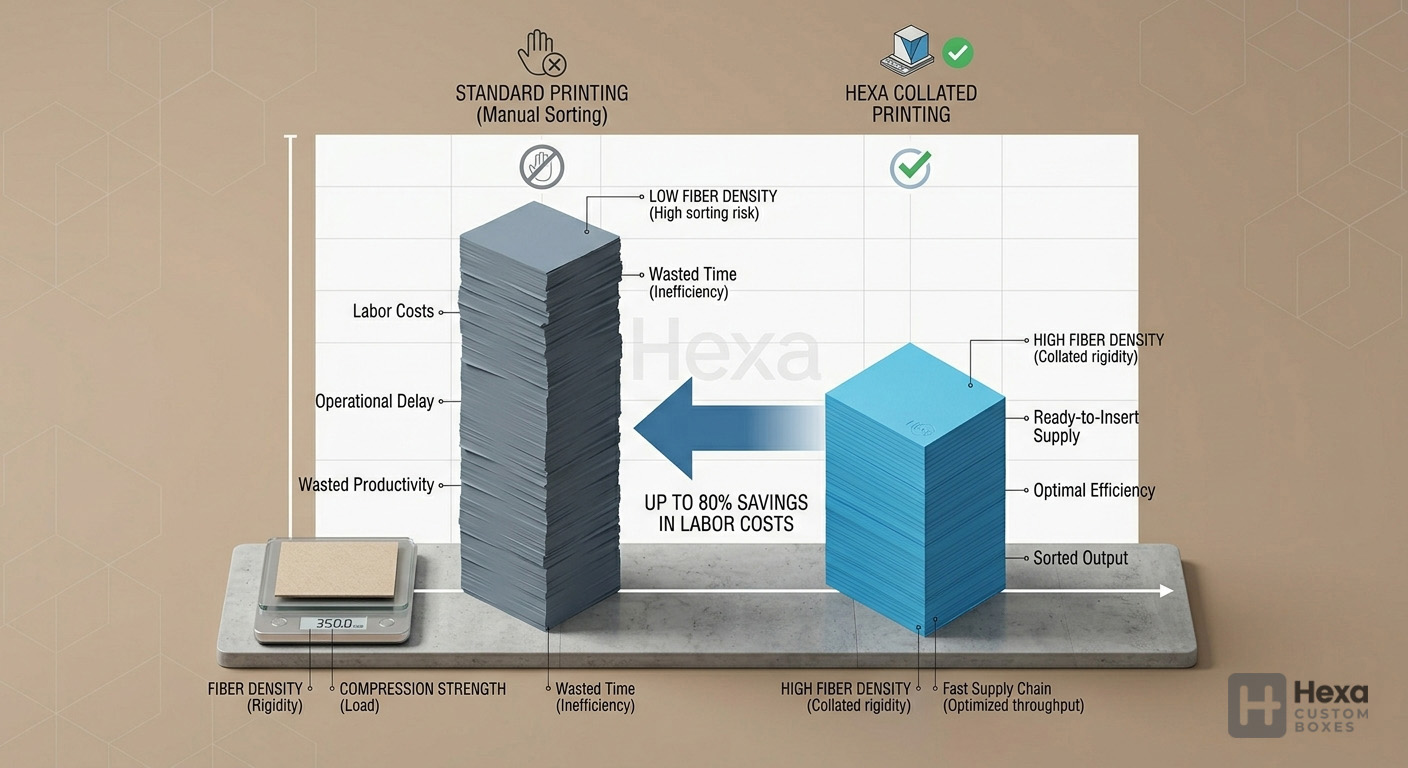
If you are ordering uncollated inserts for a complex packaging run, you are essentially offloading the sorting labor onto your own production staff. While this might look cheaper on a quote, it creates a massive “hidden” overhead.
Why Manual Sorting Kills Profit Margins
- The “Search” Factor: When a packer has to reach into three different piles to assemble a set of manuals, they lose rhythm. This adds seconds per box, which adds up to hours per shift.
- The Error Penalty: The cost of a customer complaint due to a missing instruction page or a duplicate document is not just the cost of re-shipping—it is the damage to your brand reputation and the potential loss of future LTV (Lifetime Value) from that customer.
- Space Constraints: Managing uncollated stock requires significantly more floor space, as you need to maintain separate stations for each document type, increasing your warehouse footprint.
Comparative Cost-Benefit Analysis
The table below illustrates the trade-off between standard printing (uncollated) and premium, ready-to-insert (collated) services.
| Cost Variable | Uncollated Printing | Collated Printing |
| Initial Print Price | Lower | Higher |
| Handling Labor | High (Internal) | Negligible (Outsourced) |
| Error Correction Costs | High (QC/Returns) | Near Zero |
| Workflow Speed | Bottlenecked | Optimized/High Velocity |
| Break-Even Point | Best for very low volume | Best for mass-market/scale |
The “Hexa” Strategy: Maximizing ROI
At Hexa Custom Boxes, our mission is to help you minimize the Total Landed Cost of your packaging. We achieve this by moving the value-added work to our production facility, where our automated systems perform at a fraction of the cost of manual labor.
- Reducing Human Error: Our systems use precision-weighted counts and optical sensors. We guarantee that every set is complete. By eliminating the manual sorting step, you ensure that your production line keeps moving at a consistent speed, allowing for accurate forecasting and scheduling.
- Scalability: As your brand grows, manual sorting becomes unsustainable. By integrating collated printing into your packaging design now, you are building a scalable workflow that can handle 100 boxes today or 10,000 boxes tomorrow without needing additional staff.
- Asset Allocation: By saving money on manual labor, you can re-allocate those resources—or that budget—to higher-impact areas like premium finishes, eco-friendly materials, or more sophisticated structural designs for your custom boxes.
Conclusion: Investing in Efficiency
The bottom line is that collated printing is an investment in throughput. For any business aiming to scale, the slight premium paid for collated documents is often the cheapest “insurance policy” you can buy against assembly delays and customer errors.
We advise our clients to look at their “packaging cycle time”—the time it takes for one finished box to be fully assembled, filled, and ready for shipment. If you find that your packaging team is spending more time sorting than packing, it is time to switch to a collated printing model.
VI. Conclusion: Partnering for Professionalism
In the competitive landscape of modern commerce, your packaging is the final, most tangible representation of your brand’s commitment to quality. Whether you are scaling an e-commerce empire, launching a premium tech device, or refining your subscription box experience, the details that go inside the box—the instruction manuals, the warranty cards, the welcome inserts—are not mere afterthoughts. They are the final touchpoints that define the customer journey.
As we have explored throughout this guide, the choice between collated and uncollated printing is more than a technical preference, it is a strategic operational decision.
Elevating Your Brand Integrity
When your components arrive at your facility pre-collated, you are doing more than just saving time—you are ensuring consistency. Every single unit that your customer receives will be identical, perfect, and professional. You are effectively “engineering out” the potential for human error and replacing it with the reliability of automated systems. A customer who opens a box to find perfectly organized, sequential inserts immediately perceives a higher level of care and brand authority. That is the essence of professionalism.
A Partnership for Scalable Growth
At Hexa Custom Boxes, our mission extends beyond manufacturing durable and aesthetically pleasing boxes. We strive to be a holistic partner in your supply chain. We understand that your profitability is tied directly to your assembly velocity and operational efficiency.
By integrating our professional printing capabilities with our structural packaging expertise, we help you:
- Reduce Labor Costs: By removing the “sorting bottleneck” from your floor.
- Eliminate Quality Control Risks: By ensuring every set is complete and correctly ordered before it reaches you.
- Optimize Workflow: By providing “box-ready” components that allow your team to maintain maximum throughput.
Take the Next Step with Hexa
Packaging is an ecosystem where print, structure, and fulfillment must work in perfect harmony. Don’t let disorganized inserts compromise the hard work you’ve put into your product and its presentation.
Are you ready to streamline your packaging operations and elevate your unboxing experience?
Let’s turn your packaging assembly into a high-precision, low-friction operation. Reach out to the experts at Hexa Custom Boxes today. Whether you need a technical audit of your current insert workflow or are ready to transition to premium, pre-collated print solutions, our team is here to ensure your brand stands out, every time a box is opened.
Final Resource Summary: Your Checklist for Success
| Step | Action Item |
| Audit | Review your current “Days to Pack” for your top-selling products. |
| Identify | Determine if your inserts currently require manual sorting or assembly. |
| Consult | Reach out to the Hexa team to discuss your current document complexity. |
| Optimize | Transition your high-volume SKUs to a collated printing model. |
| Scale | Monitor your reduction in labor costs and improved pack-out speed. |
Your journey to professional, efficient, and high-impact packaging begins with the right partner. Let’s build your brand’s reputation, one perfect box at a time.