















Description
Custom Fence Partitions That Keep Fragile Products Apart From Factory to Doorstep
One broken bottle in a case of twelve does not just cost you that bottle. It costs you the whole order, the return shipping, the replacement, and the customer relationship. Glass shards in a skincare kit, cracked candle jars rattling against each other, electronics scratched against neighboring units: product-on-product contact is one of the most preventable causes of shipping damage there is.
Custom fence partitions from Hexa Custom Boxes eliminate the contact entirely. Each product sits in its own cell, separated by interlocking cardboard walls on every side. Nothing moves. Nothing touches. Nothing breaks.
What a Fence Partition Actually Is and Why It Is Called That
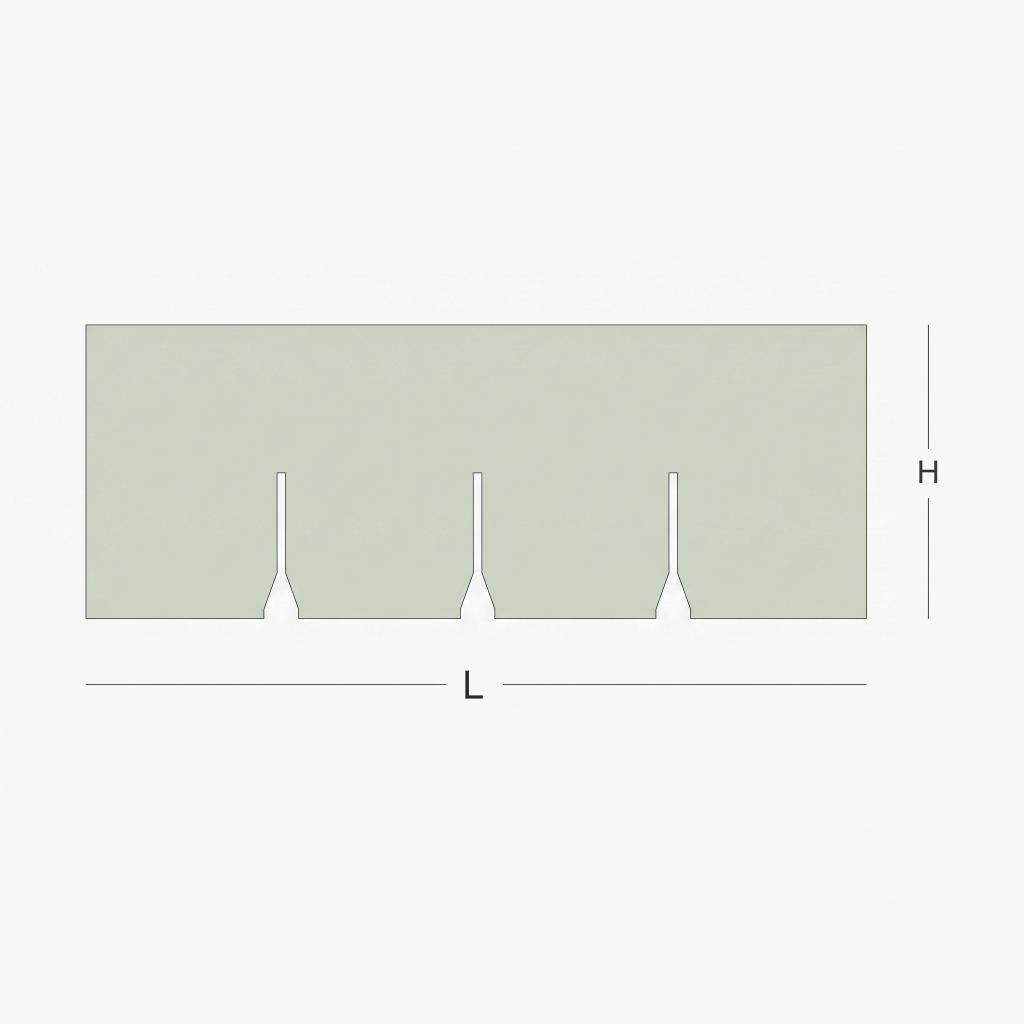
A fence partition is a set of cardboard strips that interlock in a grid pattern inside a box, creating individual cells for each product. The strips slot together at right angles through matching cuts made at exactly half the height of each strip, so the pieces lock flat without glue and the assembled grid looks exactly like the top of a chain-link fence viewed from above.
That interlocking slot-and-tab construction is what distinguishes a fence partition from other insert types. It is self-supporting once assembled, fills the full interior footprint of the box, and holds every cell wall rigid without adhesive, fasteners, or tools.
What fence partitions protect against:
- Collision damage: Products in adjacent cells cannot swing, tip, or knock against each other even under the impact and vibration of ground freight or parcel shipping.
- Breakage: Glass bottles, jars, candles, and ceramics stay separated so a single weak unit cannot trigger a chain reaction across the whole case.
- Label scuffing and marring: Bottles and jars spinning against bare cardboard or neighboring products during transit ruins labels before the product reaches the retailer or consumer. Cell walls stop the rotation entirely.
- Product shifting: Loose products shift to one end of the box under inertia and stack weight. A fence partition holds every unit in its designated position through the full journey.
Fence Partition vs Other Insert Types: Choosing the Right One
Fence partitions are one of several internal protection options. Here is an honest comparison so you choose the right structure for your product.
| Insert Type | How It Works | Best For | Limitation |
|---|---|---|---|
| Fence partition (this) | Interlocking grid of strips, one cell per product | Multi-unit glass, bottles, jars, candles | Rectangular cell shapes only |
| Punch partition | Single flat sheet with punched-up cell walls, no interlocking | Lower-cost single-layer separation | Less rigid than interlocking fence |
| Straight dividers | Parallel strips only, no cross-strips | Simple row separation, non-fragile items | No lateral separation between units in the same row |
| Die-cut foam insert | Foam cut to exact product shape | Premium products, irregular shapes, scratch-sensitive surfaces | Higher cost, not recyclable |
| Molded pulp tray | Formed pulp shaped to the product | Eco-forward brands, curved or irregular shapes | Minimum quantities and tooling cost |
Choose a fence partition when you need a rigid, fully separating grid for fragile or collision-sensitive products and a recyclable, paper-based solution.
The Spec Information You Actually Need to Order a Fence Partition
This is where most buyers get stuck and most suppliers give no guidance. Here is exactly what determines whether a fence partition works or fails.
Cell count: How many products per row and how many rows in the box. A 2×3 grid gives six cells, a 3×4 gives twelve, and so on. Count the units per shipment and decide whether they are arranged portrait or landscape in the box.
Partition height: The height of each cardboard strip, which should match or slightly exceed the height of the product sitting in the cell. If the partition is too short, the product tips over the top of the wall. If it is too tall, the lid of the outer box cannot close flush.
Slot depth: Each strip has slots cut at intervals to interlock with the cross-strips. The slot depth must be exactly half the partition height so the two pieces meet at the center when assembled and the top edge is perfectly level. This is the detail that determines whether the grid sits flat or buckles.
Cell interior dimensions: Each cell must be slightly larger than the widest point of the product, with enough clearance for the product to drop in easily but not so much clearance that it can tip or rock. For round bottles and jars, the cell is sized to the maximum diameter plus 2 to 3mm of clearance per side.
Send us: your box interior dimensions (L x W x H), product dimensions (diameter or footprint, height), units per box, and whether the product has a label that needs contact-free protection. We handle the rest.
Material Options and When to Use Each
| Material | Best For | Key Advantage |
|---|---|---|
| Chipboard | Cosmetics, perfume, pharmaceutical glass, premium retail | Clean white surface, protects labels, FDA-approvable finishes available |
| SBS (Solid Bleached Sulfate) | High-end retail, DTC unboxing, gift sets with glass | Premium appearance, water-resistant options, FDA-approved for food contact |
| Kraft corrugated (E-flute) | Wine, spirits, hot sauce, olive oil, lightweight fragile goods | Good cushioning from the flute, eco-forward look |
| Corrugated B-flute | Heavy bottles, industrial glass, bulk case shipping | Maximum wall rigidity and stacking strength |
| Recycled chipboard | Sustainable brands, cost-sensitive runs | Fully recyclable, lower unit cost |
For most DTC glass bottle shipments, chipboard or SBS gives the cleanest unboxing while protecting labels. For wholesale case shipping and heavy bottles, B-flute corrugated is the right call.
How to Assemble a Fence Partition (Step by Step)
Nobody explains this. Here is how a standard interlocking fence partition goes together.
- Separate the two sets of strips: the row strips (running the length of the box) and the column strips (running the width).
- Lay the row strips flat and parallel, spaced according to the cell width.
- Take one column strip and align the slots over the corresponding slots on the row strips.
- Press down so the slots interlock at the midpoint of each strip. The assembled cross should be flat and even with no gaps at the joints.
- Repeat for each column strip until the full grid is assembled.
- Drop the assembled partition into the outer box so it sits flat on the base.
- Load each product into its cell from above. For bottles, lower them in straight so the label does not catch the partition edge.
Total assembly time for a 3×4 grid: About 30 to 45 seconds by hand. No tools, no glue.
Industries and Products That Rely on Fence Partitions
| Industry | Typical Use | Notes |
|---|---|---|
| Wine and spirits | 6-pack and 12-pack bottle shippers | B-flute corrugated for heavy bottles |
| Craft beer and beverages | Case shipping for glass bottles | Corrugated with food-safe liners |
| Candles and home fragrance | Jar candle multi-packs | Chipboard or SBS to protect labels |
| Cosmetics and skincare | Glass serum, toner, and perfume bottles | SBS for premium unboxing |
| Hot sauce and specialty food | Multi-bottle gift sets | FDA-compliant SBS or food-safe kraft |
| Pharmaceuticals and supplements | Glass vials and bottle sets | FDA-approvable SBS or chipboard |
| Electronics and components | Small parts, components, accessory kits | Chipboard or corrugated to spec |
| Ceramics and giftware | Mugs, ornaments, fragile sets | Corrugated E-flute or chipboard |
Packaging Expert Tip: Match the Partition Height to the Bottle Shoulder, Not the Total Height
Here is the detail that separates a fence partition that works from one that lets your bottles tip and clink.
Most buyers spec partition height equal to the total bottle height, but that is usually wrong. A bottle is widest at the base and narrows toward the shoulder and neck. The cell wall only needs to reach the shoulder of the bottle because above the shoulder the bottle naturally tapers inward and cannot tip. A partition strip that runs to the full bottle height costs more board, closes tighter in the box, and adds unnecessary weight to the shipment.
Spec the partition height to reach the widest point of the bottle plus about 10mm, and size the cell interior to that widest diameter. The bottle sits secure in its cell, the partition assembly drops in and out of the box cleanly, and the lid closes flush.
One more: For any product with a paper label, spec the cell interior with a minimum 3mm clearance per side and a smooth chipboard or SBS material on the partition walls. Label-to-cardboard friction over hundreds of miles of vibration is what scuffs labels, not impact. Clearance and a smooth wall surface are what prevent it.
What Every Hexa Order Includes
These terms apply to every order without exception or fine print:
- No die charges and no plate charges, zero hidden setup fees
- Low 100-piece minimum for test runs or full production
- 8 to 10 business day turnaround from approved artwork
- Free dielines and ready-to-use templates
- Free 24/7 structural and print support from real packaging people
- 100% recyclable board stock on every order
Stop Paying for Breakage You Could Have Prevented
One fence partition per box costs a fraction of one damaged product claim. Get yours spec’d correctly the first time and ship with confidence from the first run.
Get your free quote today. No setup fees, low 100-piece minimum, delivered in 8 to 10 business days.
- 👉 Request a Free Quote
- 📞 Talk to a packaging expert — free 24/7 support
- ✉️ Email us anytime: hello@hexacustomboxes.com