












Description
Custom Header Cards: The Most Economical Retail Packaging Decision You Can Make
Most retail packaging decisions involve a trade-off between cost and presentation. A header card is the exception. It is a single printed card that costs a fraction of a box, transforms a plain poly bag into finished retail packaging, carries full-color branding and a barcode, and hangs the product on a peg hook in one motion.
Done correctly, a header card does everything a basic product box does for display purposes, at a fraction of the cost and with none of the assembly complexity. Done incorrectly, it hangs crooked on the hook, tears away from the bag under the product weight, or presents a barcode that will not scan under the hang-hole gloss coating.
Custom header cards from Hexa Custom Boxes are built around the three details that determine whether a header card works at retail: the fold score position, the hang hole placement, and the board weight matched to what it needs to hold.
The Three Types of Header Card (and Why the Distinction Matters)
This is where every competitor’s page fails the buyer. There are three structurally different products that all go by the name “header card” and each requires a different dieline, a different board weight, and a different design brief.
| Type | Structure | How It Attaches | Best For |
|---|---|---|---|
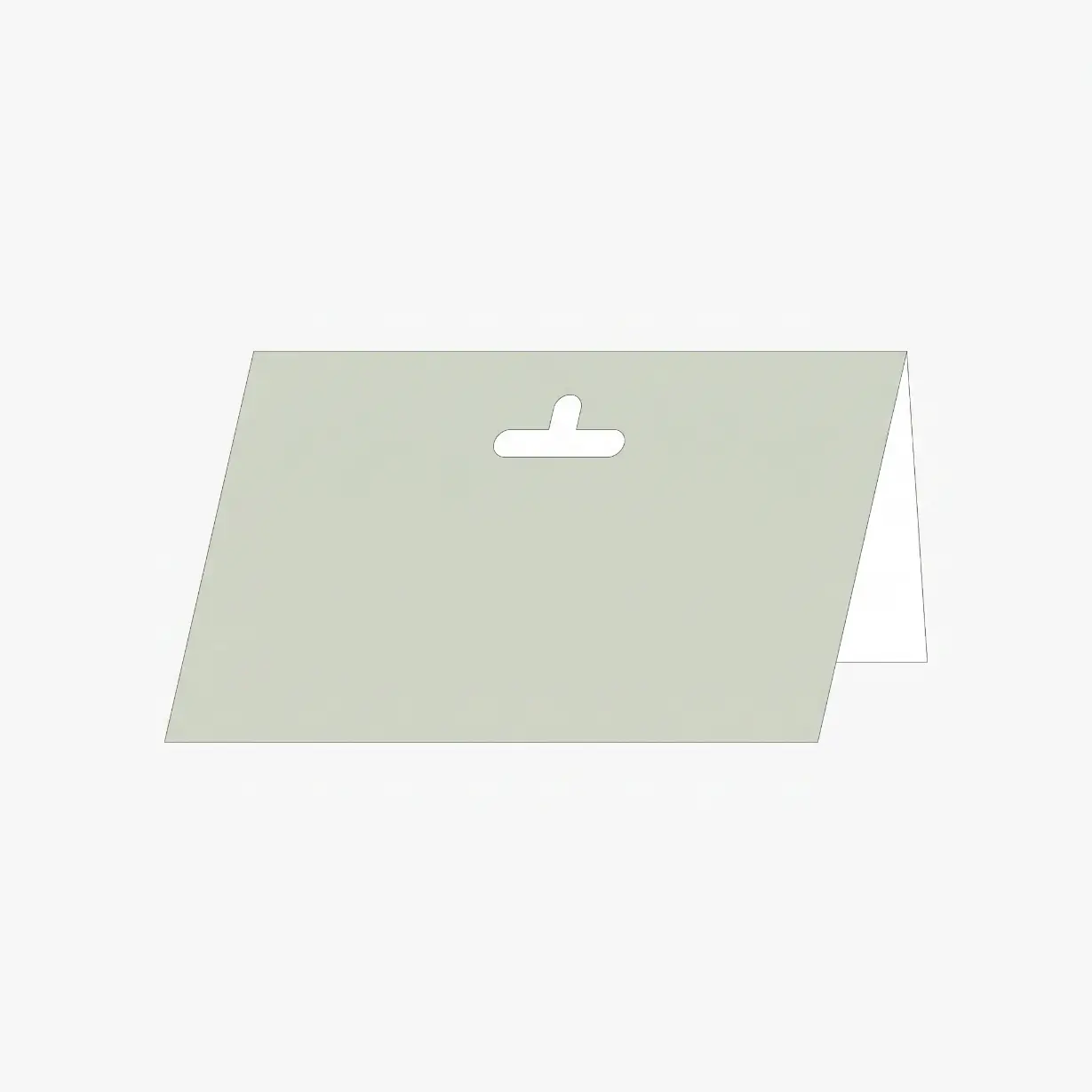
| Fold-over bag topper | Card folds at a scored center line, top half and bottom half clamp over the poly bag opening | Staple, double-sided tape, glue, or heat seal through both layers and the bag | Most common: jewelry, accessories, small retail products in clear poly bags |
| Flat backer card | A single flat panel that sits behind the product or blister tray, not folded | Glued or heat-sealed to a blister or product back | Blister packaging, toys, electronics accessories, any product in a formed tray |
| Standalone hang card | A single printed card with hang hole, no bag, product attached directly by pinning, tying, or shrink-wrapping | Product attached mechanically to the card itself | Bulky items, garden accessories, tools, items that cannot go into a standard poly bag |
Tell us which type you need when requesting a quote. The dieline, the board weight, the fold score position, and the hang hole placement are all different for each.
The Fold Score Position: The Detail That Determines Whether the Card Hangs Straight
This is the structural specification nobody explains and the one that most directly affects how the card looks on the retail hook.
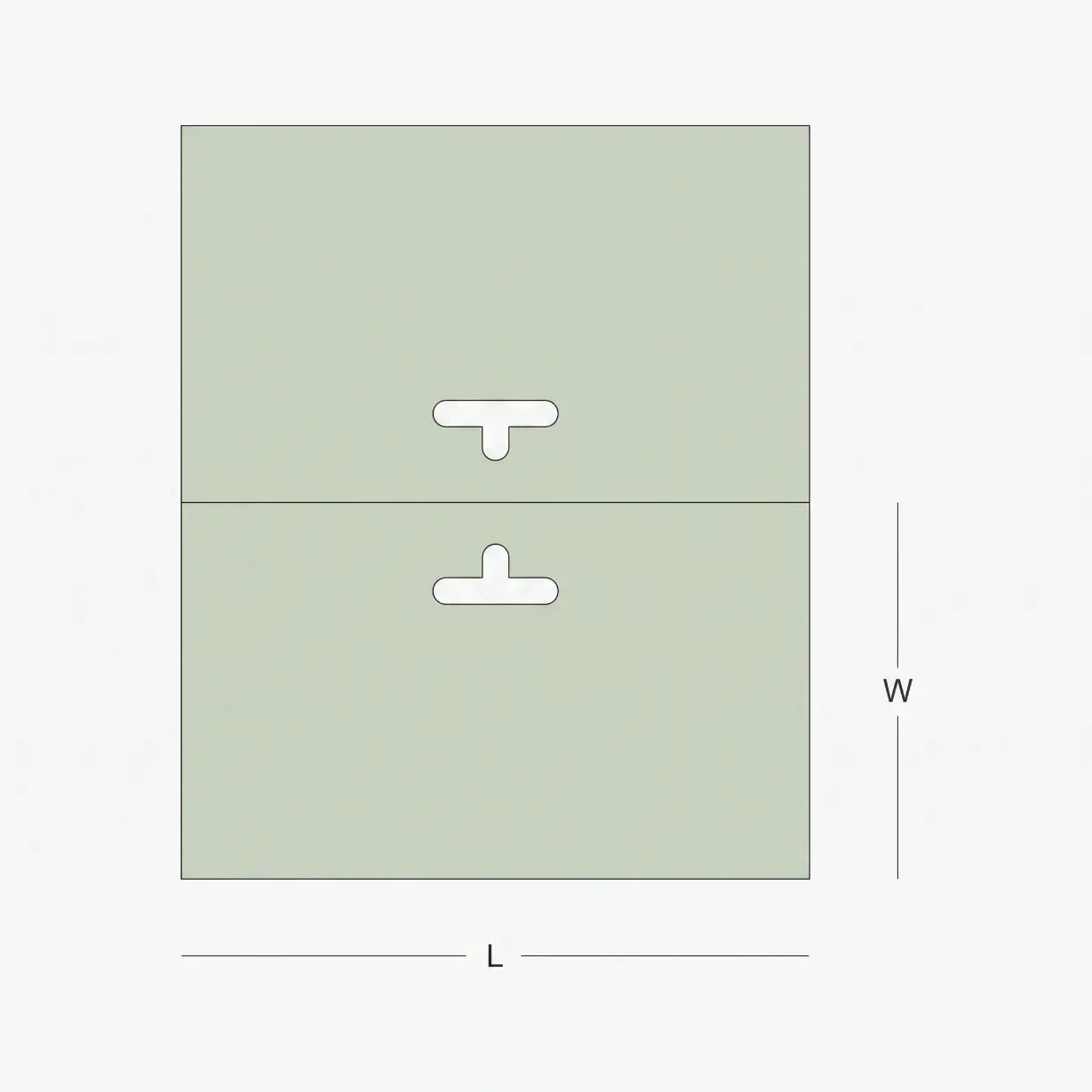
A fold-over header card has a score line at the center of the card where it folds over the bag opening. The score line must align exactly with the top edge of the poly bag. If the score sits too high above the bag opening, the bottom half of the card is too short to cover the bag top and the product can slide out. If it sits too low, the fold pushes down into the product area and the card hangs forward off the hook at an angle.
To get the fold score right, we need:
- The bag width at the opening (the card must be at least as wide as the bag, plus 3 to 5mm on each side)
- The bag opening height from the top of the bag to the top of the product inside (this determines where the fold sits relative to the bag contents)
- The total card height above and below the fold (the above-fold section carries the hang hole and front branding; the below-fold section covers the bag top on both sides)
Send us your bag dimensions and we position the fold score precisely before the dieline is approved.
Capacity Scoring: For Thick or Bulky Products That a Standard Fold Cannot Cover
Capacity-scored header cards solve the problem for thicker or bulkier products. A wider U-shaped fold area allows the card to wrap easily around items that are too thick for a standard center-scored fold.
A standard header card scores at the center and the two halves clamp flat against each other over the bag opening. This works well for flat or thin products: accessories, jewelry, small cosmetics, single-serve sachets.
For thicker products, a standard fold either gaps at the bag top (the two halves cannot meet because the product pushes them apart) or crumples the bag top as the fold forces the thick product downward.
A capacity score adds a U-shaped or accordion-fold section at the center that accommodates the product thickness. The card still folds over the bag top cleanly, and the hang hole and front branding align correctly, but the fold section has enough depth to accommodate a product that would buckle a standard center score.
Specify the maximum thickness of your product at the bag opening and we design the capacity score to match.
Hang Hole Options: Round, Euro Slot, and Sombrero
| Hang Hole Style | What It Is | Best For |
|---|---|---|
| Round hole (standard) | Simple punched circle, typically 4.75mm or 6mm | Standard pegboard hooks, most retail applications |
| Euro slot | Oval or rectangular slot for standard European hook gauge | Slatwall and pegboard at the euro hook standard |
| Sombrero (butterfly) | Die-cut flap that loops over a wide hook | Clip strips, wider hooks, hooks without a defined tip |
For most US retail pegboard, a round hole at 4.75mm (3/16 inch) or a Euro slot is the right default. Confirm the hook gauge with the retailer before finalizing the dieline. A hole too small for the hook will not slide on; a hole too large will let the card tip and spin on the hook.
Multiple Hang Holes: When and Why
Multiple hang holes distribute the weight of heavier products to reduce sagging and keep the card and product hanging correctly.
A single hang hole concentrates the entire hanging load at one point. For lightweight products under approximately 100g in a standard poly bag, a single hole handles the load reliably. For heavier products, the card can stretch at the single hang point and begin to sag, tilting the product forward and distorting the branding presentation.
Two or three hang holes spread the load across a wider area and keep the card and product hanging flat and true. We calculate the hole count and spacing based on the product weight and the card width.
Attachment Methods: Choosing the Right One for Your Operation
| Method | How It Works | Best For | Limitation |
|---|---|---|---|
| Staple | One or two staples through both card layers and the bag top | High-volume retail, most durable attachment | Staple heads visible; some retailers prefer no-staple |
| Double-sided tape | Tape strip between the card layers adheres to bag top | Clean finish, no visible hardware | Slower than staple; less durable under heavy product weight |
| Glue | Adhesive applied to inner card surfaces, pressed together over bag top | Invisible closure, clean finish | Requires drying time; not suitable for heat-sensitive bags |
| Heat seal | Heat applied to both layers bonds them through the bag top | Fast, strong, and fully secure for food-adjacent applications | Requires heat-seal equipment on the packing line |
For most retail and gifting operations, staple is the right default for its speed and reliability. For premium beauty and cosmetics where staple heads are not acceptable, double-sided tape or glue gives a cleaner finish. For food-adjacent applications, heat seal provides the most secure and hygienic closure.
Barcode Placement: The Design Constraint Nobody Mentions
The barcode should stay flat, readable, and away from folds, staples, seals, hole cuts, or high-gloss effects that may affect scanning.
Three rules that determine whether a header card barcode scans at the POS:
Rule 1: Keep the barcode off the fold. A barcode that runs across the fold score line distorts when the card is folded and will not scan reliably from either half.
Rule 2: Keep the barcode off the gloss. Spot UV and high-gloss lamination reflect POS scanner light and can produce false reads or no reads. If the design includes a Spot UV finish, the barcode zone must be masked out from the coating. We build the coating mask into the dieline by default when a barcode is present.
Rule 3: Keep the barcode away from the hang hole. A barcode printed too close to the hang hole is partially obscured when the card is on the hook, and the scanner can pick up the hole edge as a false bar. Keep the barcode at least 10mm from the nearest hole edge.
Board Weight Guide: Matching the Card to the Product and Display Period
| Board Weight | Feel | Best For | Product Weight Limit |
|---|---|---|---|
| 14pt SBS | Lightweight, flexible | Jewelry, small accessories, short display periods | Under approximately 50g per card |
| 16pt SBS | Moderate rigidity | Most retail accessories, cosmetics, food-adjacent | Under approximately 100g per card |
| 18pt SBS | Substantial, credit-card-like rigidity | Heavier accessories, hardware, toys, long retail runs | Under approximately 200g per card |
| Kraft (natural brown) | Flexible to moderate | Eco-forward brands, artisan products, natural aesthetics | Weight by thickness, same as above |
| Recycled board | FSC-certified options | Eco-certified programs | Same as corresponding thickness |
Material choice should not be based on thickness alone. Buyers should also consider stiffness, folding behavior, ink coverage, and hole strength. A 16pt SBS with a soft-touch laminate may feel more premium than an 18pt SBS without it, even though the unlaminated card is physically thicker. We recommend board weight based on product weight and display duration, not just the premium feel.
Print That Makes a Simple Card Look Finished
A header card has four printable surfaces: the front of the top panel, the back of the top panel, the front of the bottom panel (the inner surface against the bag back), and the front of the bottom panel exterior (the side facing out when folded).
- Front top panel: Primary brand surface. Logo, product name, hero image, brand color. The surface the shopper reads at the hook.
- Back top panel: Product details, ingredients, usage instructions, compliance copy, website, QR code.
- Inside surfaces (facing the bag): Can carry a brand message or pattern visible through a clear bag to reinforce the brand at close range.
Print finishes: PMS spot-color matching, full CMYK, Spot UV accents (keeping barcode zone clear), matte or gloss lamination, foil stamping for premium retail positioning.
Packaging Expert Tip: Design the Front Panel for the Hook Height, Not the Hand
Here is the design brief that most brands get backwards on header cards.
Most brands design the header card front panel the way they would design a product label: for someone holding the product at arm’s reach and reading the details. That is the wrong brief for a peg display card.
At a retail pegboard or slatwall, the card hangs at approximately 48 to 72 inches from the floor depending on the hook position. The shopper approaches from a walking distance of one to two meters. They have approximately two seconds to decide whether to stop.
Brief the front panel for that two-second window at that hook height. That means:
- Brand name large and at the top of the front panel, not centered between the hang hole and the fold
- One dominant visual element, not a busy layout with five different graphic elements
- A single clear benefit line in type large enough to read from one meter
- High contrast between the type and the background
Put the product detail, ingredients, and extended copy on the back panel. That is what the shopper reads after they have already taken the card off the hook and are holding it. Brief each panel for its audience and its viewing distance separately.
What Every Hexa Order Includes
These terms apply to every order without exception or fine print:
- No die charges and no plate charges, zero hidden setup fees
- Low 100-piece minimum for test runs or full production
- 8 to 10 business day turnaround from approved artwork
- Free dielines and ready-to-use templates
- Free 24/7 structural and print support from real packaging people
- 100% recyclable board stock on every order
One Card. Sealed Bag. Hang Hole. Full-Color Brand. Done.
The most economical retail packaging decision you can make, built to the score position, the hang hole, and the barcode placement that makes it work at retail.
Get your free quote today. No setup fees, low 100-piece minimum, delivered in 8 to 10 business days.
- 👉 Request a Free Quote
- 📞 Talk to a packaging expert — free 24/7 support
- ✉️ Email us anytime: hello@hexacustomboxes.com