













Description
Custom Peptide Boxes Built for the Market That Has Outgrown Generic Pharmaceutical Packaging
In 2022, a peptide brand could ship in a plain white folding carton with a printed label and be taken seriously. The market was smaller, the buyers were more forgiving of packaging, and the visual standard was low.
That is no longer the case. When PeptideSciences.com shifted to minimalist label design in 2023, customer surveys reported a 27% increase in perceived credibility and repeat order rates rose by 15%. By 2025 and 2026, the peptide market has matured into a competitive commercial category where packaging is a credibility signal that buyers read before they read the label.
Custom peptide boxes from Hexa Custom Boxes are built for the three distinct markets that the peptide category now contains, each with different packaging requirements, different structural formats, and a different design brief.
The Three Peptide Packaging Contexts: Which One Are You Building For
This is the framework every competitor page skips and the one that determines every other specification decision.
Context 1: Research Supply
Lab researchers, universities, and compounding pharmacies sourcing peptides for legitimate research applications prefer packaging that does not look like consumer branding. Clean typography, scientific naming conventions, and precise information hierarchy are what build trust with a research peptide buyer. Cluttered graphics and lifestyle imagery do not work in this category. Many research supply buyers actively prefer plain, unmarked exterior packaging to avoid any appearance of consumer drug marketing.
Right format: Folding carton SBS or kraft, minimal or plain exterior, RUO statement prominent, compound name and batch information hierarchy leading the label, no lifestyle imagery.
Context 2: Commercial Wellness and Aesthetic Medicine Brand
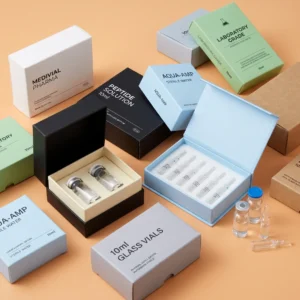
Commercial brands selling to medical professionals, wellness consumers, or aesthetic medicine practitioners need packaging that communicates pharmaceutical credibility and premium quality from the first visual contact. The dominant aesthetic treats the box like a laboratory logbook: core active ingredient percentages in the largest typeface, clinical Morandi greys, muted blues, and raw whites.
Right format: Rigid magnetic closure box with Grade A EVA foam insert, soft-touch matte lamination exterior, foil-stamped brand mark, COA document pocket, cold chain compatibility.
Context 3: Clinical and Aesthetic Medicine Distribution
Compounding pharmacies and clinical distributors supplying botulinum toxin, HA filler, or GLP-1 analogs to aesthetic medicine practices need GMP-aligned materials, tamper-evident seals, chain-of-custody documentation, and cold chain packaging that performs at 2 to 8°C or lower.
Right format: GMP-aligned SBS folding carton with tamper-evident tear strip, cold-chain compatible materials, DSCSA serialization space, COA documentation slot in the insert.
The RUO Statement: What It Is, Where It Goes, and How to Make It Work Visually
This is the compliance requirement that every peptide packaging page ignores and that every research peptide brand must get right.
FDA guidance requires that every container of a Research Use Only peptide clearly state Research Use Only, Not for Human Consumption, include the manufacturer’s name, batch number, and expiration date, and avoid any therapeutic or drug claims.
The RUO statement is mandatory on every primary and secondary package for research peptides. Getting it wrong creates regulatory exposure. Burying it or making it unreadable creates a different kind of exposure: the appearance of trying to minimize a required disclaimer.
The design approach that works: allocate a dedicated compliance strip at the bottom of the label. The strip uses the same sans-serif family as the rest of the label but at a slightly smaller point size, maintaining uniformity without adding clutter.
Practical RUO placement on the outer box:
- Front panel: RUO statement in the compliance strip at the bottom of the panel, below the brand name and compound name. Minimum 8-point type, not reversed out of a dark background (light type on dark makes compliance text harder to read for regulators).
- Side panels: RUO repeated alongside lot number and expiry date.
- Back panel: Full RUO statement in a dedicated compliance block, alongside batch certificate reference and manufacturer information.
The RUO statement does not have to look like a warning label that dominates the face of the box. It needs to be visible, legible, and consistent. A compliance strip at the bottom of the front panel achieves all three without compromising the brand hierarchy above it.
The 2025-2026 Peptide Packaging Design Language
This is the design brief that builds credibility in this market and that no packaging supplier page explains.
The goal is to balance scientific rigor with cosmetic elegance, looking professional without feeling like a cold prescription drug. The design language that achieves this balance in 2026 has converged on a set of consistent principles.
Typography: Clean, legible sans-serif for compound names, dosage, and compliance information. A complementary serif for the brand name and any brand story copy. Keep hierarchy consistent: larger type for the product name, smaller for research and compliance text. Avoid decorative or display typefaces. The compound name (BPC-157, TB-500, Semaglutide analog, Retatrutide) should be the largest, most prominent text on the front panel.
Color palette: Clinical Morandi greys, muted blues, raw whites, and black. The dominant aesthetic relies on clinical Morando greys, muted blues, and raw whites. Avoid saturated consumer-product colors. The palette should look like it belongs in a clinical environment, not on a supplement retail shelf. Dark matte finishes (navy, charcoal, black) work for premium commercial brands. White with dark typography works for research supply.
Information hierarchy on the front panel:
- Compound name (largest element, top third of panel)
- Concentration per vial or per dose
- Volume or quantity
- Brand name (secondary, below compound name or in corner)
- RUO compliance strip (bottom of panel)
What not to put on the front panel: Lifestyle imagery, athlete photography, testimonial claims, wellness buzzwords, or any element that looks like a consumer supplement label. A minimalist approach using precise typography, calming color psychology, and high-quality materials communicates that your brand is scientifically backed, reliable, and safe.
Multi-SKU Line System: Packaging 10, 20, or 50 Peptide Compounds Cohesively
Commercial peptide brands do not typically sell one compound. They sell a line: BPC-157, TB-500, CJC-1295, Ipamorelin, Semaglutide, Tirzepatide, Retatrutide, and many more. The packaging system must make every box immediately recognizable as part of the same brand while making every compound instantly distinguishable from every other.
The system approach that works:
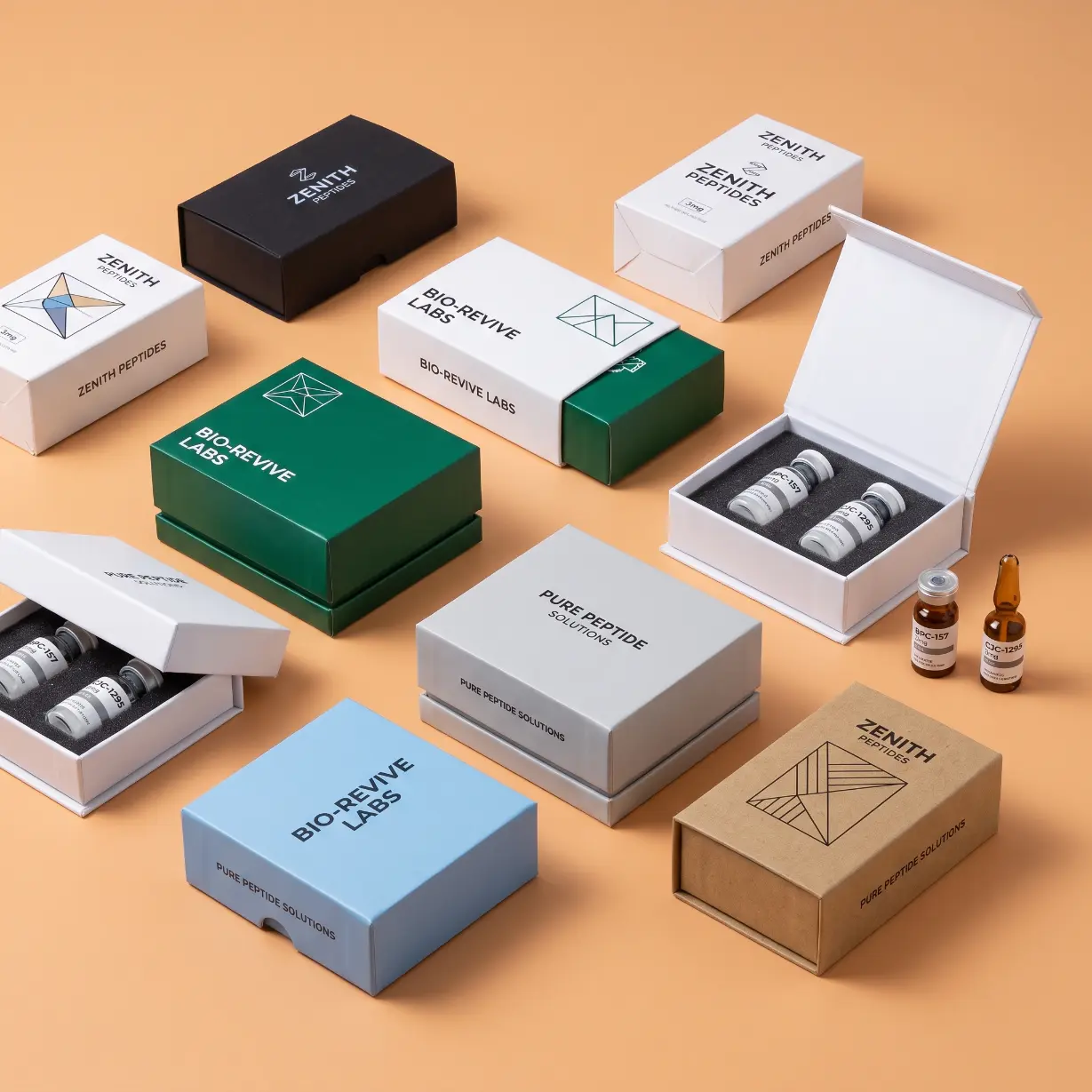
Fixed elements across all SKUs: Box format (rigid magnetic or folding carton, consistent across the line), typography system (same typeface family and size hierarchy), color palette and finishes (same exterior material and coating across all boxes in the line).
Variable elements per SKU: Compound name (the largest typographic element, changes per box), accent color (one variable color per compound to enable instant visual differentiation on a shelf or lab bench), concentration callout (prominently displayed, changes per compound).
Practical implementation: Design a master dieline and a master typographic template. Apply the compound name, concentration, and accent color as the only variables. Every box in the line is produced from the same master, which reduces setup time, eliminates production errors, and creates a consistent visual system that projects professionalism at scale.
When you have more than five SKUs, bring this conversation to us before briefing the individual box designs. The system approach saves production cost, eliminates visual inconsistency, and builds a stronger brand presence than designing each box independently.
The COA Document Pocket: The Packaging Feature That Research and Clinical Buyers Expect
This is the functional packaging feature that commercial peptide brands increasingly standard and that no supplier page addresses as a design element.
A Certificate of Analysis (COA) is a third-party laboratory report verifying the compound identity, purity, and potency of each batch. Research buyers, clinicians, and regulatory-adjacent consumers increasingly expect the COA to accompany the product in a way that makes it immediately accessible without hunting through secondary packaging.
COA pocket options:
A die-cut slot in the foam insert, sized to hold a folded A4 or letter COA document, visible when the box is opened but protected from moisture and handling damage.
A printed card pocket on the inside of the outer box wall, bonded to the interior panel, holding the COA in a branded sleeve.
A QR code on the box exterior or inside lid linking to a digitally hosted COA, with the batch number and vial lot number pre-encoded in the QR so each unit links to its specific batch certificate.
For research supply, a physical COA in the packaging is expected. For premium commercial brands, the QR code authentication approach adds a digital credibility layer while keeping the physical packaging clean.
Structural Format Options for Peptide Boxes
| Format | Context | Key Features |
|---|---|---|
| Folding carton SBS (plain) | Research supply, lab distribution | Minimal branding, RUO prominent, functional insert, flat-shipping |
| Folding carton SBS (branded) | Mid-tier commercial brands | Full-color exterior, tamper-evident seal, flat-shipping |
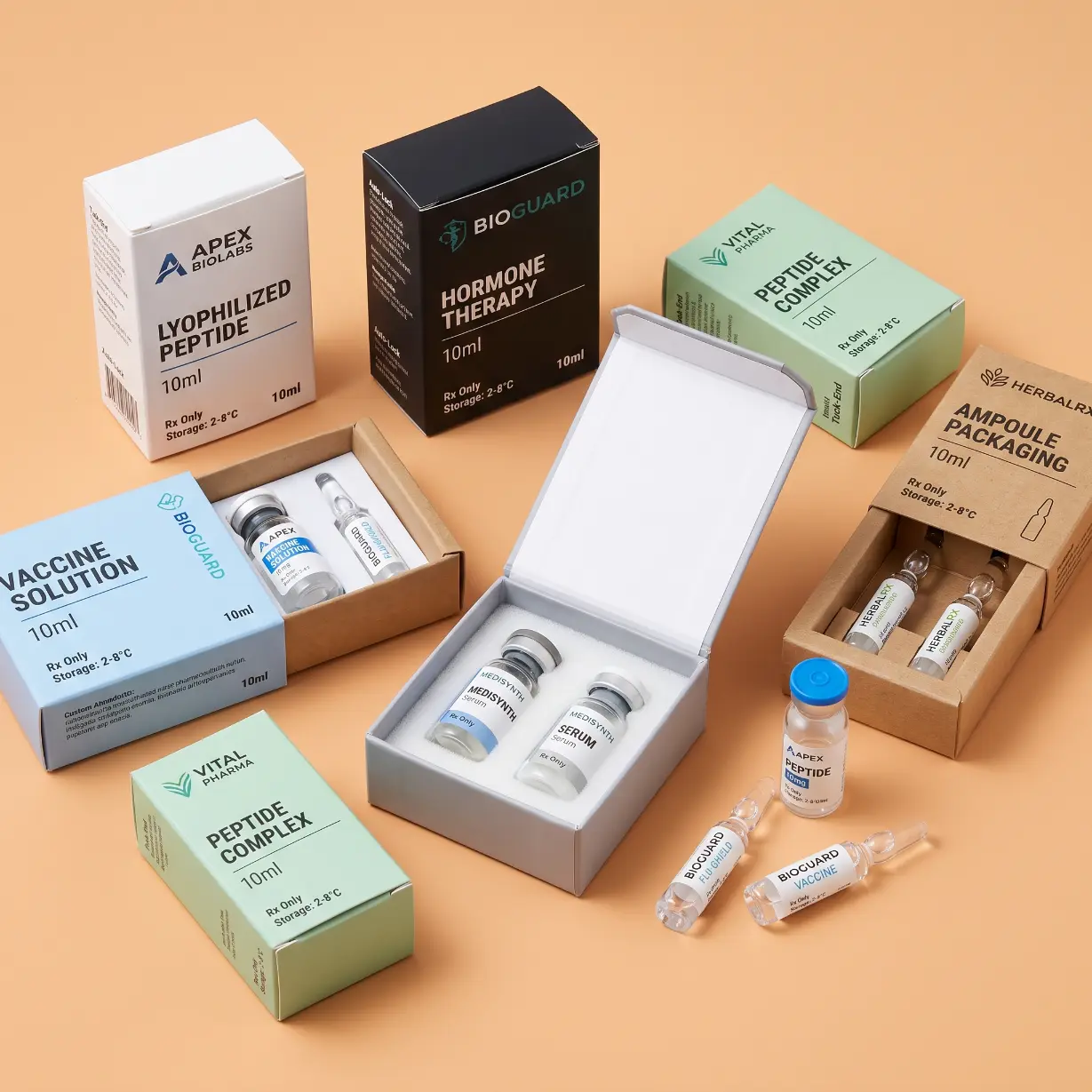
| Rigid magnetic closure | Premium commercial and clinical brands | Soft-touch matte, foil stamp, Grade A EVA foam, COA pocket |
| Rigid drawer slide | Premium presentation, multi-vial kits | Distinctive reveal, foam insert tray, brand manifesto inside |
| Two-piece lid and base | Clinical aesthetics, gifting formats | Clean lift-off, premium interior, COA slot in tray |
| Cold chain mailer box | Shipping with cold packs, refrigerated distribution | Insulated liner, corrugated outer, moisture-resistant |
Cold Chain and GMP-Aligned Options for Clinical Peptide Distribution
For peptide products distributed to clinical practitioners, aesthetic medicine practices, and compounding pharmacies, the packaging must perform at refrigerated storage temperatures and through cold chain shipping.
Refrigerated storage (2 to 8°C): Specify moisture-resistant coated SBS for the outer carton. Standard uncoated SBS softens under condensation when moved from cold storage to room temperature.
GLP-1 analog and lyophilized compound packaging: UV-blocking materials for light-sensitive compounds. PE-coated board or opaque construction for the outer box. EVA foam insert rated for low-temperature storage.
Chain-of-custody documentation: For clinical distribution where each unit must be traceable to a batch certificate and a recipient, incorporate a serialized QR code on the outer box plus a physically included COA in the packaging insert.
Tamper evidence for clinical supply: Perforated tear strip across the magnetic or tuck closure, void tamper-evident seal on the seam, or heat shrink band around the closed box.
Peptide Box Specifications at Common Vial Sizes
| Vial Format | Box Interior | Insert | Recommended Format |
|---|---|---|---|
| Single 3ml ISO 2R peptide vial | 22 x 22 x 62mm | Grade A EVA foam | Rigid magnetic or folding carton SBS |
| Single 5ml peptide vial | 28 x 28 x 75mm | Grade A EVA foam | Rigid magnetic or SBS |
| Single 10ml ISO 10R peptide vial | 30 x 30 x 80mm | Grade A EVA foam | Rigid magnetic or SBS |
| Duo kit (10ml vial + bacteriostatic water vial) | 64 x 30 x 80mm | Dual-slot EVA, labeled slots | Rigid magnetic or two-piece |
| 5-vial research set | Custom to vial count | 5-slot EVA tray | Rigid two-piece or corrugated outer |
| 10-vial clinic pack | Custom to vial count | 10-slot EVA tray | Folding carton SBS or corrugated |
Packaging Expert Tip: Lead With the Compound Name, Not the Brand Name
Here is the single design decision that separates peptide packaging that builds trust from packaging that undermines it.
Secondary packaging offers a larger canvas to educate buyers. Present key claims with clean minimalist typography. The goal is to balance scientific rigor with cosmetic elegance.
In most consumer product categories, the brand name leads and the product name follows. For peptide packaging, this hierarchy is reversed. The reason is the buyer.
A clinician, researcher, or informed wellness consumer picking up a peptide box is not leading with brand loyalty. They are leading with compound verification: is this the compound I ordered, at the concentration I need, from a batch I can verify? The compound name answers all three questions. The brand name is secondary credibility confirmation.
Put the compound name large at the top of the front panel. Put the concentration directly below it. Put the brand name smaller, either beneath the concentration or in the upper corner. The compliance strip goes at the bottom.
This hierarchy is counterintuitive for brands used to consumer product packaging. It feels like the brand is being deprioritized. But in the peptide market, the compound name hierarchy is exactly what makes the brand feel credible. The brand that leads with the compound is the brand that looks like it knows what it is selling.
What Every Hexa Order Includes
These terms apply to every order without exception or fine print:
- No die charges and no plate charges, zero hidden setup fees
- Low 100-box minimum for test runs or full production
- 8 to 10 business day turnaround from approved artwork
- Free dielines and ready-to-use templates
- Free 24/7 structural and print support from real packaging people
- 100% recyclable board stock on every order
The Box That Tells the Buyer the Compound Is Real Before They Open It
Compound name leading. Concentration prominent. RUO compliant. COA accessible. Cold chain ready. The packaging system built for a market that now reads the box before it trusts the vial.
Get your free quote today. No setup fees, low 100-box minimum, delivered in 8 to 10 business days.
- 👉 Request a Free Quote
- 📞 Talk to a packaging expert — free 24/7 support
- ✉️ Email us anytime: hello@hexacustomboxes.com