
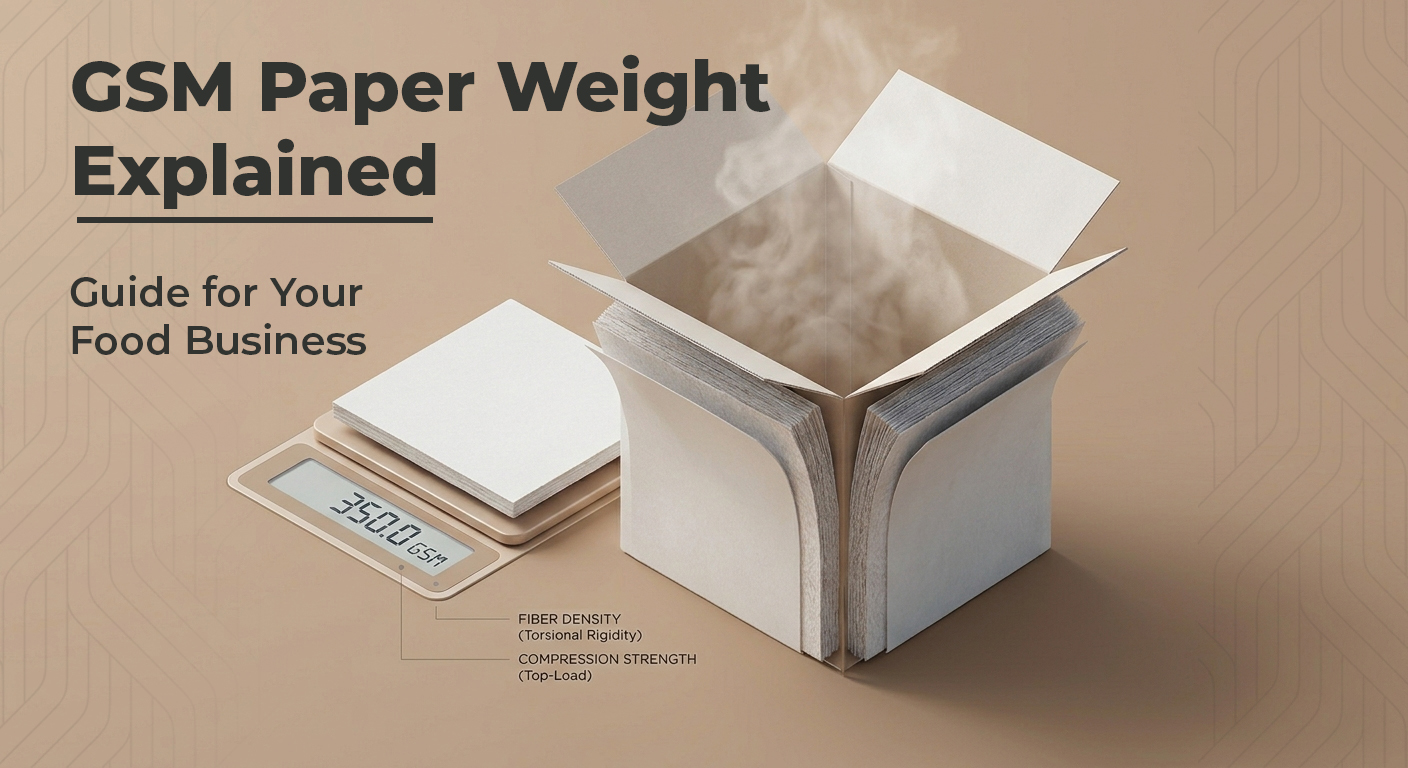
In the world of food service, your packaging is the first physical touchpoint of your brand. But beyond the aesthetics—the logos, the colors, and the typography—lies a technical specification that dictates whether your product arrives in “Mint Condition” or a soggy, structural mess.
That specification is GSM.
If you have ever had a burger box collapse under steam, or a pastry bag turn translucent from butter-wicking, you have experienced a GSM failure. At Hexa Custom Boxes, we believe that understanding the physics of paper weight isn’t just for engineers—it’s for every entrepreneur who wants to protect their margins and their reputation.
This guide will break down the science of GSM and provide a roadmap for choosing the exact weight for your specific food niche.
Part 1: The Physics—What is GSM?
GSM stands for Grams per Square Meter. It is a metric measurement of the “substance” or “grammage” of a sheet of paper or paperboard.
The Measurement Standard
Imagine taking a sheet of paper that is exactly one meter wide and one meter long (1m x 1m). If you place that sheet on a high-precision scale, the weight in grams is its GSM.
- Low GSM (30 – 100): These are “Paper” grades. They are flexible, foldable, and lightweight.
- Medium GSM (100 – 200): These are “Text” or “Heavy Paper” grades. Often used for premium flyers or thin wraps.
- High GSM (200 – 450+): These are “Paperboard” or “Cardstock” grades. These have structural “Stiffness” and “Bending Resistance,” which are required for boxes.
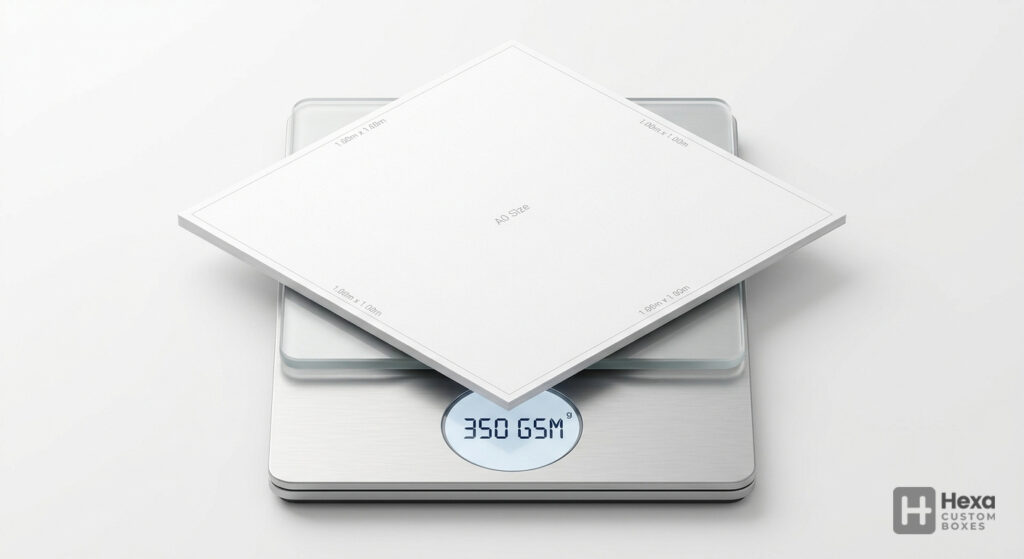
Technical Note: GSM measures weight, not necessarily thickness (which is measured in Caliper or Points). While they are related, two different 300GSM boards can have different thicknesses based on how “densely” the fibers are pressed together.
Part 2: The GSM Spectrum for Food Businesses
In the food industry, paper isn’t just a carrier, it’s a barrier. Here is how the different weight classes perform in a kitchen and delivery environment.
1. The Lightweight Class (30GSM – 90GSM)
- Primary Use: Wraps, Liners, and Tissue.
- The Science: At this weight, the paper is highly porous. In food, these are usually treated with an “Oil-Resistant” (KIT) coating or wax.
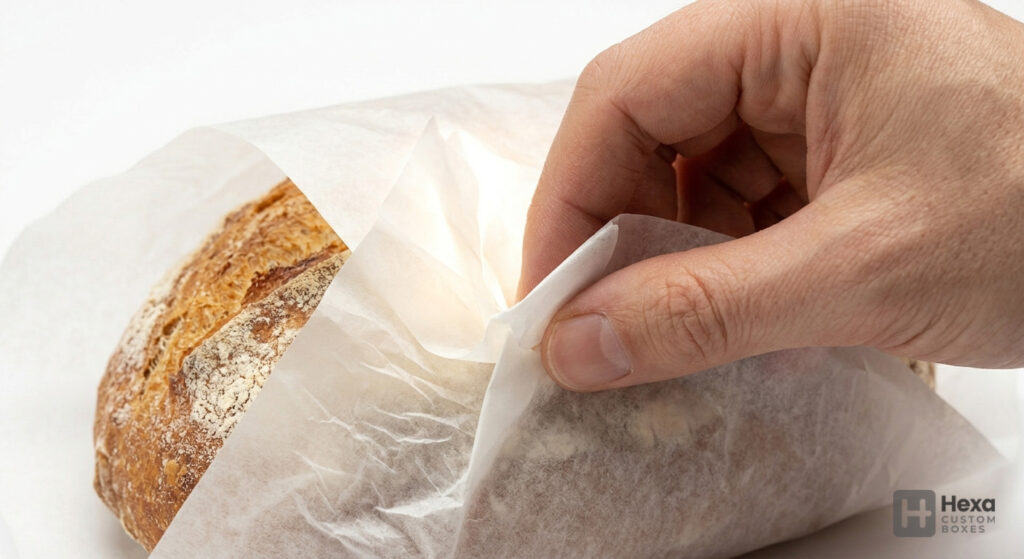
Application:
- 30 – 40GSM: Standard deli wrap for cold sandwiches.
- 50 – 70GSM: Greaseproof liners for fries or “basket liners.”
- 70 – 90GSM: Heavy-duty bread bags or flour sacks.
2. The Mid-Weight Class (100GSM – 180GSM)
- Primary Use: Takeaway Bags and Menus.
- The Science: This weight offers “Tensile Strength”—the ability to resist tearing when under a vertical load (like carrying a heavy soda).
Application:
- 100 – 120GSM: Standard brown Kraft paper bags.
- 150 – 180GSM: Premium “Boutique” paper bags with twisted handles.
3. The Structural Class (200GSM – 450GSM)
- Primary Use: Folding Cartons and Boxes.
- The Science: This is where we measure “Compression Strength.” These weights must hold their shape while stacked 5-10 high in a delivery rider’s thermal bag.
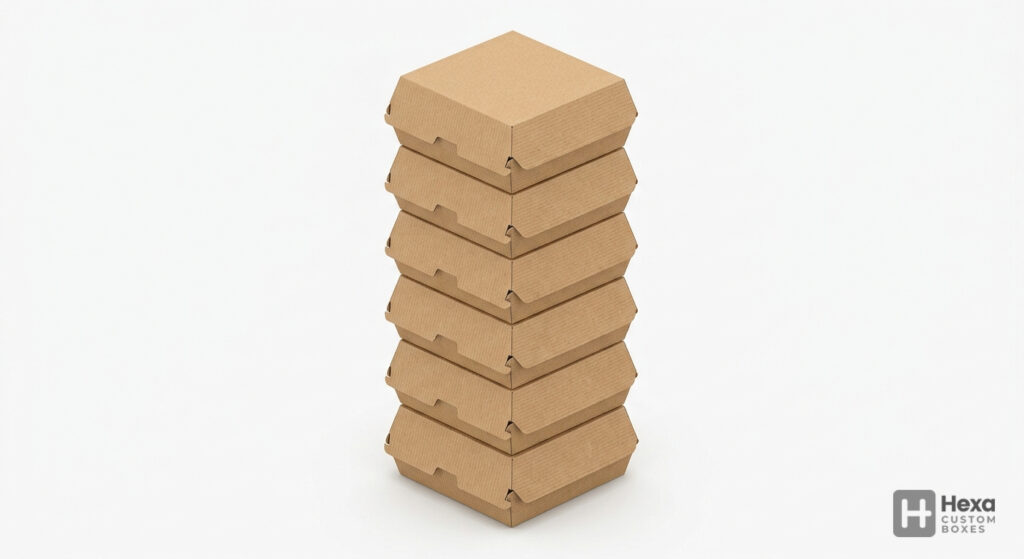
Application:
- 250GSM: Lightweight pastry boxes or small tea boxes.
- 300 – 350GSM: The “Gold Standard” for burger boxes, noodle boxes, and lunch trays.
- 400GSM+: Heavy-duty meal kits or multi-bottle carriers.
Part 3: Choosing by Niche—A Guideline for Success
Every food type has a “Mechanical Requirement.” Using too high a GSM wastes money, using too low a GSM wastes food.
A. The Bakery & Pastry Sector
Pastries are light but fragile. The main enemy here is “Butter Migration.”
- Recommended GSM: 250 – 300GSM.
- Engineering Focus: You need a high Caliper-to-Weight ratio. You want a box that feels “stiff” but doesn’t add unnecessary weight to the product. Always ensure the internal liner is PE-Coated to prevent the grease from softening the paper fibers.
B. The Burger & Fried Chicken Sector
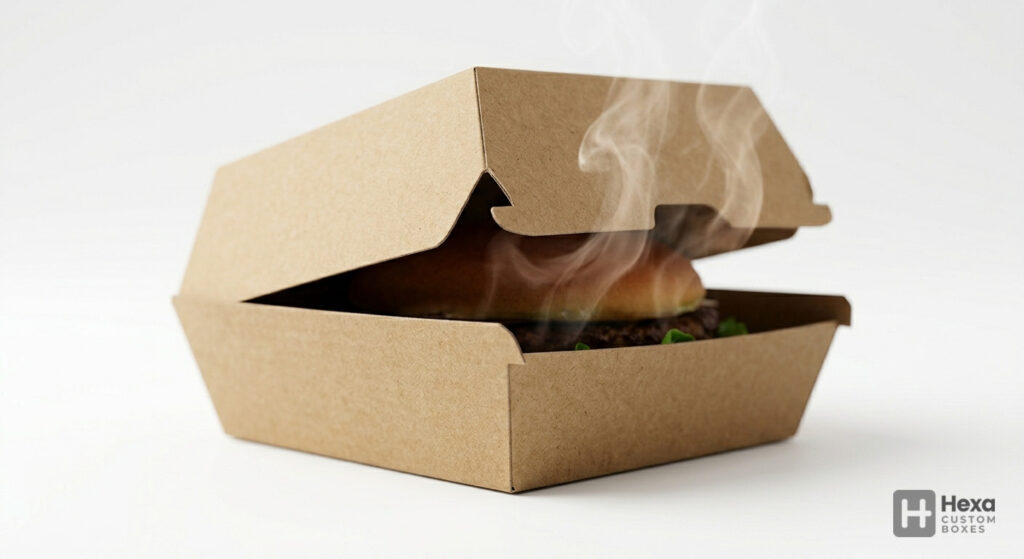
This is the most demanding environment for paperboard. The enemy is “Condensation.”
- Recommended GSM: 300 – 350GSM.
- Engineering Focus: Hot food releases steam. Steam softens paper fibers. To compensate for this “Fiber-Relaxation,” we use a higher GSM with a “High-Bulk” specification. This ensures the box remains rigid even when the humidity inside the box hits 90%.
C. The Gourmet Confectionery Sector (Chocolate/Macarons)
This is about “Tactile Prestige.”
- Recommended GSM: 350 – 400GSM (Rigid or Semi-Rigid).
- Engineering Focus: For luxury food items, the “Snap” of the lid is a branding tool. A 400GSM SBS (Solid Bleached Sulfate) board provides a surgical white finish and a heavy, premium hand-feel that justifies a higher price point.
Part 4: The Impact of GSM on Shipping and Sustainability
Choosing the right GSM isn’t just a quality control move, it’s a financial and environmental one.
1. Cost Optimization (The “Goldilocks” Zone)
If you order 100,000 boxes, the difference between 350GSM and 300GSM can be thousands of dollars in material costs. At Hexa Custom Boxes, we use CAD-Stress Testing to see if we can reduce your GSM by 10% while maintaining structural integrity through “Reinforced Corner-Folds.”
2. Environmental Footprint
Higher GSM means more wood pulp. If your brand is “Eco-Conscious,” you can opt for a lower GSM but utilize a “Micro-Flute” (N-Flute) corrugated structure. This uses two thin layers of paper with a “wave” (flute) in the middle, providing the strength of 400GSM paperboard with 20% less total fiber.
Part 5: Common Mistakes to Avoid
1. Ignoring the “Grain Direction”
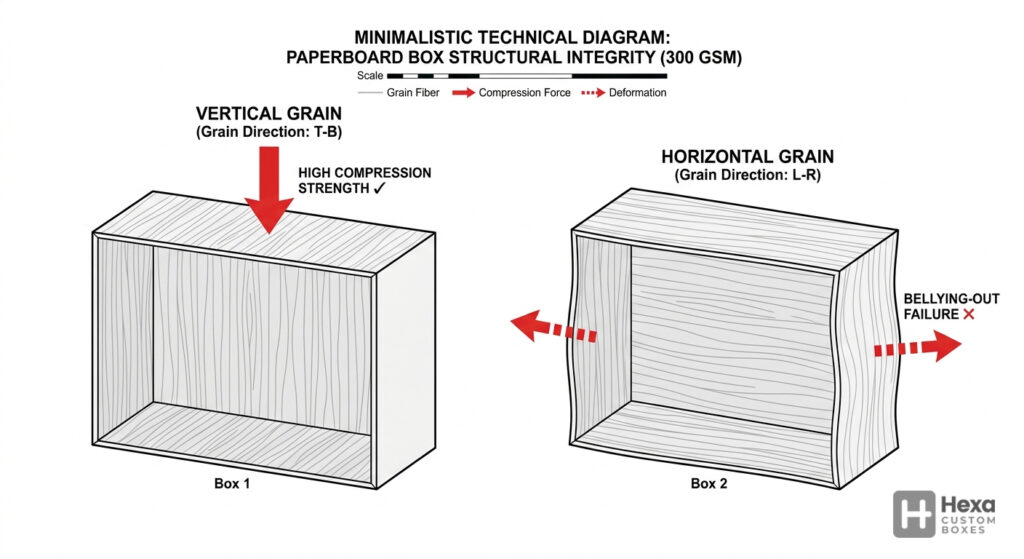
Paper has a grain, just like wood. If your box is designed with the grain running horizontally instead of vertically, it will “Belly-Out” even if the GSM is high. Always ensure your manufacturer aligns the grain for Vertical Compression.
2. Over-specifying for Cold Foods
Cold salads or cold wraps don’t produce steam. You don’t need a 350GSM fortress for a Caesar salad. A 250GSM box with a high-clarity window is more than sufficient and more cost-effective.
3. Forgetting the “Stacking Factor”
Will your boxes be stacked in a delivery bag? If yes, the bottom box must support the weight of the boxes above it. This is where you cannot compromise on GSM. A “Stack-Test” is essential before finalizing your order.
Part 6: How to Test GSM at Your Business
If you have a sample from a competitor or a previous supplier and want to know its quality, follow the “Hexa Stress Test”:
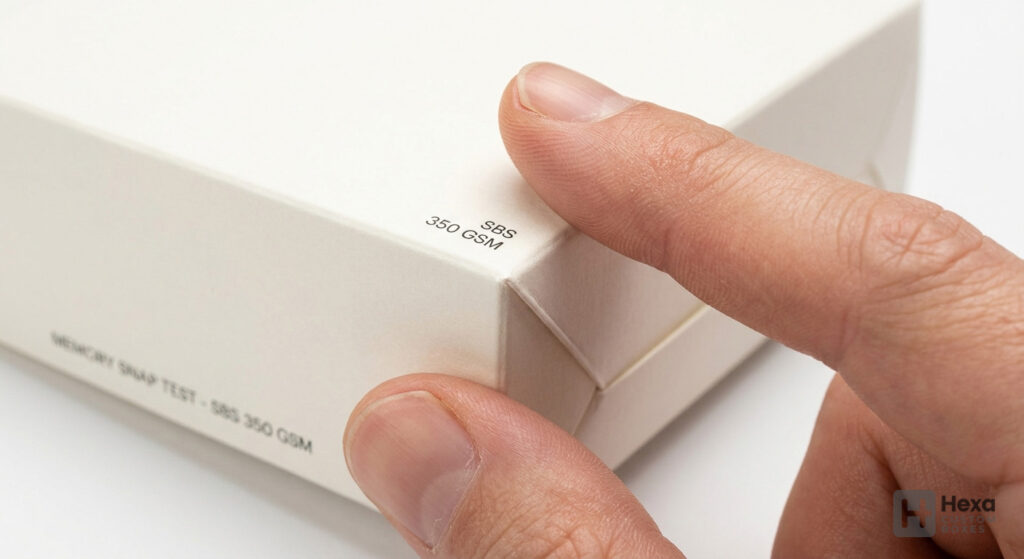
- The Bend Recovery: Fold a corner of the box. Does it snap back, or does it stay limp? A high-quality GSM board has “Memory.”
- The Moisture Test: Place a drop of water on the unprinted side. How long does it take to soak in? If it’s instant, the GSM is likely low and the fiber density is poor.
- The Precision Weigh: If you have a gram scale, cut a 10cm x 10cm square. Weigh it in grams and multiply by 100. That is your GSM.
Part 7. Cost Optimization: How to Save Money Without Losing Quality
In the packaging industry, “Down-Gauging” is the practice of reducing GSM without losing strength. Here is how we do it at Hexa Custom Boxes:
- Structural Creasing: By adding “Reinforcement Creases” to the corners of a box, we can sometimes use a 300GSM board to do the work of a 350GSM board.
- Lamination Strength: A 250GSM board with a thin BOPP Lamination is often stiffer and more water-resistant than a raw 350GSM board.
- The Bulk Ratio: We look for “High-Bulk” paper. This allows us to give you a box that feels thick and sturdy but actually uses less paper pulp, saving you money on material and shipping.
Summary: The Hexa Blueprint for Food Packaging
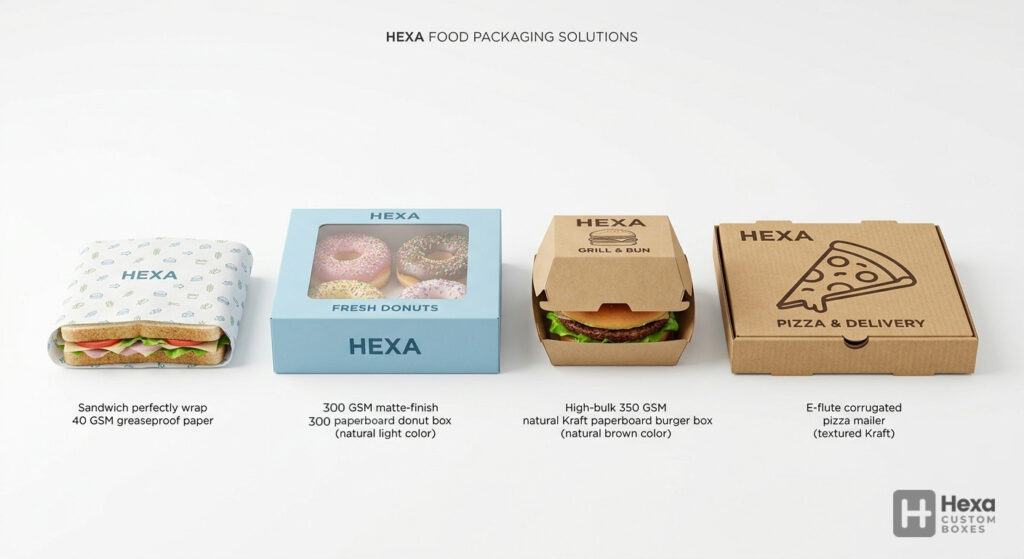
| Food Item | Recommended GSM | Substrate Type | Key Feature |
| Sandwich Wrap | 30 – 40 | Greaseproof Paper | Pliability |
| Doughnut Box | 250 – 280 | SBS Board | Oil Resistance |
| Premium Burger | 325 – 350 | Kraft/White Board | Steam Resistance |
| Pizza Box | 125 – 150 | E-Flute Corrugated | Heat Retention |
| Wine Carrier | 400 – 450 | Heavy Chipboard | Tensile Strength |
Conclusion: Engineering Your Brand’s Success
GSM is more than a number on a spec sheet, it is the silent protector of your product’s quality. When you choose the right paper weight, you are investing in the customer’s unboxing experience. You are ensuring that the burger is as hot, the pastry as crisp, and the salad as fresh as it was when it left your kitchen.
At Hexa Custom Boxes, we don’t just print boxes, we engineer them. Whether you are a local cafe or a national food chain, we help you find the “Perfect GSM”—the one that balances cost, strength, and sustainability.
Ready to find the perfect weight for your brand?
Contact our engineering team today for a structural audit of your current food packaging.
About Hexa Custom Boxes
Based in the heart of the packaging industry, Hexa Custom Boxes specializes in technical packaging solutions for the food, cosmetic, and retail sectors. We combine local market humor with global engineering standards to give your brand the edge it deserves.