














Description
Custom Vial Boxes With Foam Insert: The Protection System That Keeps Glass Intact
A vial box without foam is a container. The vial can move inside it. Movement during transit means impact. Impact on glass means breakage. And a broken pharmaceutical or cosmetic vial means a damaged product, a return, and a brand credibility problem that traces back to a missing insert.
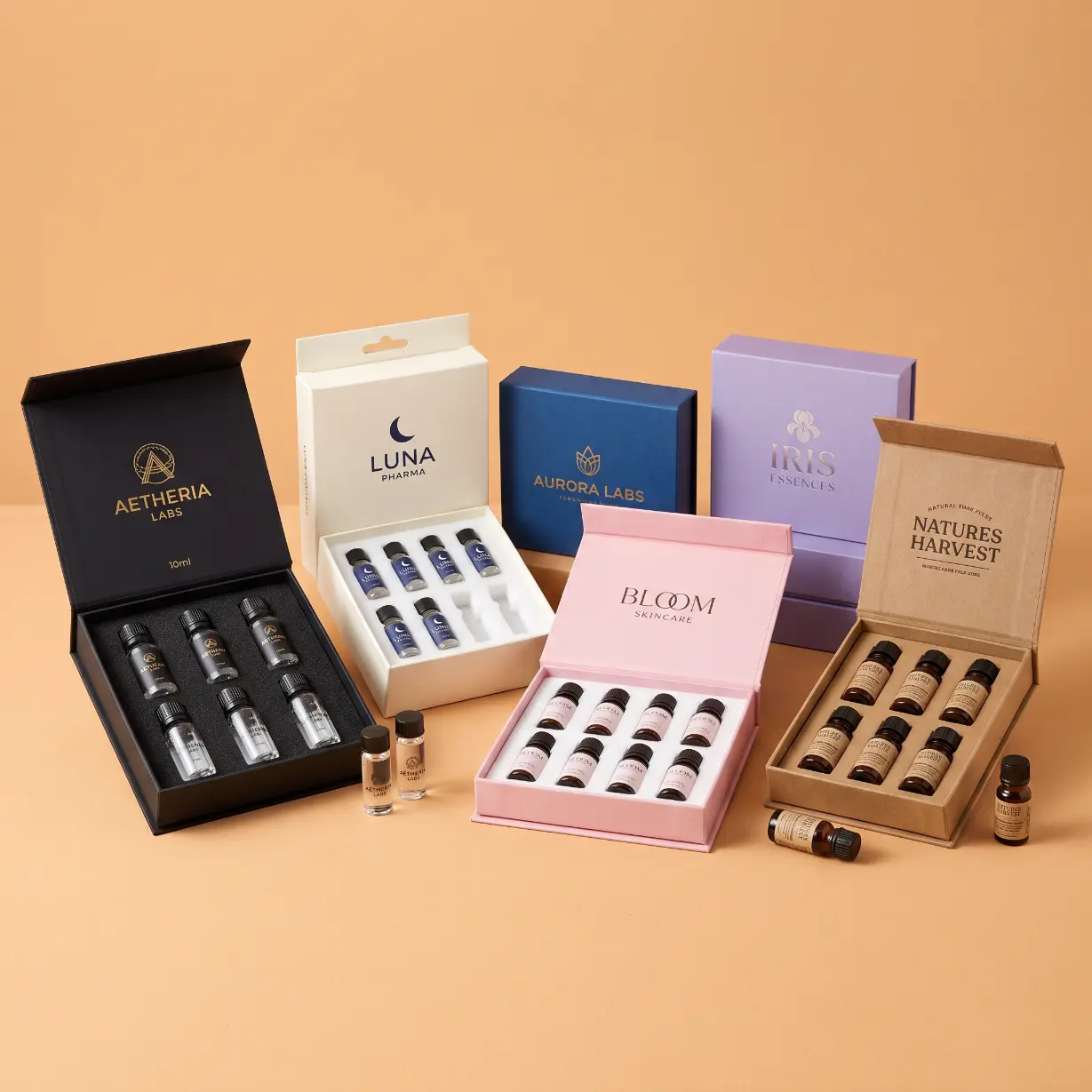
A vial box with the right foam insert is a different thing entirely. The foam cavity holds each vial in a precisely cut slot, suspended away from the box walls on all sides. The insert holds each vial in its own precisely fitted slot, so nothing moves from the moment the box is sealed to the moment your customer opens it. They absorb impact and vibration that would otherwise transfer directly into the glass.
Custom vial boxes with foam inserts from Hexa Custom Boxes are built around the foam material, the cavity cut, the density, and the color that together create the protection and presentation the vial requires.
The Three Foam Types and Which Is Right for Vial Packaging
This is the material decision every buyer faces and no US competitor explains it clearly for the vial packaging context.
EVA foam for 90% of applications: best balance of protection, cost, and appearance. PE foam for lightweight items and budget applications. PU foam for heavy-duty industrial protection.
Applied specifically to vial packaging:
| Foam Type | Properties | Best for Vial Packaging When | Limitation |
|---|---|---|---|
| EVA (Ethylene Vinyl Acetate) | Semi-rigid, excellent shock absorption, water-resistant, available in multiple densities and colors, FDA-compliant grades available | Most pharmaceutical, cosmetic, and laboratory vial applications: the standard | Less impact resistance than PE for very heavy industrial vials |
| PE (Polyethylene) | Closed-cell, lightweight, moisture-resistant, cost-effective, lower aesthetic quality | Budget-sensitive clinical and laboratory supply applications, bulk distribution | Less visually premium than EVA, fewer color options, lower precision cut quality |
| PU (Polyurethane) | Soft, open-cell, excellent cushioning for delicate surfaces, spongy texture | Very fragile thin-wall glass vials, precision optics, applications where surface marking must be zero | Absorbs moisture, not suitable for humid environments, higher cost |
For pharmaceutical retail, cosmetic serum, and essential oil vial packaging, EVA foam is the correct default in almost every case. It is the material ZEE Custom Boxes specifies as FDA 21 CFR-compliant with non-toxic PE and EVA foam inserts. It cuts cleanly to precise cavity dimensions, holds its shape through shipping, comes in the colors that match pharmaceutical and luxury brand positioning, and is the material the industry has standardized on for a reason.
The Two-Layer Foam Architecture That Creates a Suspended Presentation
This is the structural feature that separates a professional foam insert from a simple foam pad, and nobody in the US market explains it.
Most buyers imagine a foam insert as a single block of foam with holes cut in it for the vials. The professional version has two distinct layers that do different jobs.
Layer 1: The base layer A full-coverage foam panel that sits at the bottom of the box tray. Its job is to absorb vertical impact, buffer the base of the vial from the box floor, and bring the vial cavity up to the correct presentation height. The base layer thickness determines how much of the vial sits above the box rim when the lid is removed, which determines whether the vial is easy to grip and lift out.
Layer 2: The cavity layer A second foam panel, the same footprint as the base layer, with precision-cut cavities for each vial. This layer sits on top of the base and provides the lateral containment that prevents the vial from rocking or tipping. The cavity depth is sized to hold the vial at the grip zone, typically at the widest part of the body, so the vial sits stable and can be lifted out without tipping.
Together the two layers create a suspension system: the vial sits in its cavity elevated above the box base by the base layer, surrounded laterally by the cavity walls, with nothing touching the box walls directly. Impact from any direction is absorbed by foam before it reaches the glass.
An optional third layer: the lid liner can be added to the underside of the lid. This thin foam pad prevents the vial cap from rattling against the lid interior when the closed box is handled or shipped.
Cavity Cut Methods: Die-Cut, CNC-Routed, and Pick-and-Pluck
The precision of the cavity determines the fit of the vial, and the cut method determines the precision achievable.
| Cut Method | How It Works | Best For | Precision |
|---|---|---|---|
| Die-cut | A steel die presses through the foam to cut a specific shape | Standard cylindrical vial cavities, high-volume production | Good for simple shapes, consistent across large runs |
| CNC-routed | A computer-controlled router mills the exact cavity profile | Complex shapes, multi-diameter vials, mixed-vial configurations | Highest precision, best for non-cylindrical or specialty vials |
| Pick-and-pluck (slit foam) | A grid of pre-cut slits allows foam cubes to be pulled out by hand | Flexible multi-item configurations, kits with varied components, prototypes | Fastest setup, less precise fit than die-cut or CNC |
For most pharmaceutical and cosmetic vial applications with standard cylindrical vials, die-cut foam gives the right precision at production cost. For specialty vials with crimped shoulders, tapered bodies, or non-standard profiles, CNC-routing gives the exact cavity fit that prevents pressure marking on unusual glass shapes.
Pick-and-pluck panels are useful for kit boxes containing a vial plus accessories (syringe, alcohol swab, instruction card) where the accessories vary and a fixed die-cut would not accommodate the variation across different kit configurations.
Foam Color: The Detail That Changes What the Brand Communicates
Every competitor lists foam as an available option. Nobody explains that foam color is a brand decision with a clear signal hierarchy.
| Foam Color | Brand Signal | Best For |
|---|---|---|
| Black | Premium, luxury, high-value, clinical sophistication | Luxury cosmetic serums, premium essential oils, peptide and aesthetic medicine brands |
| White | Clean, clinical, pharmaceutical, sterile | Pharmaceutical dispensing, laboratory, clinical applications where clean-room association matters |
| Custom brand color | Brand-forward, distinctive, collectible | DTC brands where unboxing experience is core to the brand, limited editions |
| Natural grey | Neutral, understated, professional | Mid-tier cosmetics, corporate gifting, professional healthcare supply |
Grade A EVA foam inserts are available in the full color range. The foam color choice is made at the same time as the box exterior finish, because the two together create the complete unboxing impression. A matte black box with black EVA foam reads as luxury pharmaceutical regardless of what is inside. A white SBS carton with white foam reads as clinical and compliant.
FDA Compliance and Foam Off-Gassing: What Pharmaceutical Brands Need to Know
This is the technical detail that pharmaceutical, clinical, and medical aesthetics brands must verify and that no US supplier page addresses for vial foam inserts specifically.
Standard commodity EVA and PE foams are generally non-reactive under normal conditions. However, some foam formulations off-gas trace volatile organic compounds (VOCs) at elevated temperatures or over long storage periods. In a sealed pharmaceutical vial box, these VOCs can in theory create a contaminating environment if the foam contacts or is in close proximity to a vial with a compromised or permeable seal.
For pharmaceutical applications where this risk is relevant:
- Specify FDA 21 CFR-compliant foam: these are formulations tested and documented as non-reactive and non-contaminating in pharmaceutical secondary packaging contexts. All board, foam inserts, coatings, and printing inks across our vial box with insert range are FDA 21 CFR-compliant with non-toxic PE and EVA foam inserts and non-contaminating board surfaces.
- Specify PFAS-free foam for pharmaceutical-grade and medical aesthetics applications where PFAS contamination risk is a regulatory concern.
- For clinical use where the box serves as a secondary sterile barrier, specify foam and board materials with batch documentation and material traceability for QA sign-off.
When you request a quote for pharmaceutical applications, tell us the regulatory context and we confirm the foam specification and documentation available before production.
Vial Volume to Foam Insert Specification: A Practical Reference
| Vial Volume | Typical Vial Diameter | Recommended Cavity Clearance | Recommended Foam Density | Typical Insert Thickness |
|---|---|---|---|---|
| 2ml pharmaceutical | 16mm | 2mm per side (20mm cavity) | Medium density EVA | 40mm total (20mm base + 20mm cavity) |
| 5ml cosmetic serum | 22mm | 2.5mm per side (27mm cavity) | Medium density EVA | 50mm total |
| 10ml standard | 24mm | 2.5 to 3mm per side (29 to 30mm cavity) | Medium density EVA | 55 to 65mm total |
| 15ml essential oil | 28mm | 3mm per side (34mm cavity) | Medium density EVA | 65 to 75mm total |
| 30ml cosmetic | 35mm | 3mm per side (41mm cavity) | Medium-low density EVA | 80 to 90mm total |
These are starting-point references confirmed against your actual vial before production. Glass vial dimensions vary between manufacturers and production batches, so we always verify the cavity specification against a physical vial sample or a caliper-measured dimension sheet.
Where Vial Boxes With Foam Inserts Earn Their Keep
| Application | Why Foam Insert Fits | Recommended Foam and Color |
|---|---|---|
| Pharmaceutical retail (single vial) | Transit protection, tamper-evident presentation, regulatory compliance | White EVA, FDA 21 CFR-compliant |
| Cosmetic serum (single or duo) | Premium lift-out presentation, brand-aligned color | Black or custom color EVA |
| Essential oil gift set (multi-vial) | Glass protection in multi-unit set, premium unboxing | Black EVA, two-layer architecture |
| Peptide and aesthetic medicine | GMP-aligned materials, PFAS-free option, clinical presentation | White FDA-compliant EVA |
| Laboratory sample vials (bulk) | Transit protection for fragile glass in multi-vial configurations | Grey or white PE foam with pick-and-pluck for kit flexibility |
| Luxury fragrance (single vial) | Premium suspension presentation, collectible box feel | Black EVA with lid liner |
| Clinical diagnostics | Sterile secondary barrier, batch documentation | White FDA-compliant EVA with traceability |
Print and Finish on the Outer Box
The foam insert creates the interior experience. The outer box carries the brand and the compliance copy.
- PMS spot-color matching and full CMYK for brand-accurate exterior color
- Spot UV on the lid top for logo shine and premium shelf distinction
- Foil stamping for luxury cosmetic and pharmaceutical retail positioning
- Matte or soft-touch lamination for premium tactile exterior
- Full compliance copy on back and side panels: ingredients, dosage, lot number, expiry date, regulatory symbols
Packaging Expert Tip: Match the Foam Softness to the Vial’s Surface Finish
Here is the selection detail that prevents an expensive presentation error and that no competitor mentions.
The foam cavity holds the vial in contact with the vial surface throughout the product’s shelf life. For most standard pharmaceutical glass, this is irrelevant. For vials with printed labels, delicate screen-printed graphics, or specialty surface finishes (frosted glass, etched patterns, gold-leaf decoration), the foam surface texture and hardness can cause micro-abrasions over time through vibration during storage and shipping.
For vials with standard labels: standard die-cut EVA foam is correct.
For vials with printed or etched glass surfaces: specify a low-density, softer EVA or a PU foam cavity layer. The softer material conforms around the surface finish without applying the localized pressure that stiffer foam concentrates at the label edge.
For vials with foil or metallic surface finishes: specify a velvet-lined foam cavity where the interior of the cavity is lined with a soft fabric that eliminates any direct foam-to-surface contact.
Brief the foam insert specification at the same time as the vial surface finish. The two are connected decisions, and matching them correctly is the difference between a box that protects the vial’s presentation through its full distribution life and one that delivers micro-scratched labels to the end customer.
What Every Hexa Order Includes
These terms apply to every order without exception or fine print:
- No die charges and no plate charges, zero hidden setup fees
- Low 100-box minimum for test runs or full production
- 8 to 10 business day turnaround from approved artwork
- Free dielines and ready-to-use templates
- Free 24/7 structural and print support from real packaging people
- 100% recyclable board stock on every order
Foam Cut to the Vial. Color Matched to the Brand. Protection Built Into Every Cavity.
EVA, PE, or PU foam. Die-cut or CNC-routed. Base layer, cavity layer, lid liner. The precision insert system that keeps glass intact from factory to customer.
Get your free quote today. No setup fees, low 100-box minimum, delivered in 8 to 10 business days.
- 👉 Request a Free Quote
- 📞 Talk to a packaging expert — free 24/7 support
- ✉️ Email us anytime: hello@hexacustomboxes.com