














Description
Custom Boxed Christmas Cards: Two Buyer Types, One Keyword
The term boxed Christmas cards describes two different products that have different structural requirements, different print briefs, and different commercial purposes.
Buyer Type 1: The retail card set box
A stationery brand, gift shop, or independent card designer packaging a set of 12, 16, or 25 pre-printed Christmas card designs plus envelopes into a retail box for holiday sale. The box is a retail product in its own right: it sits on a shelf, shows the card design through a window, and is purchased by a customer who gives the cards to others.
Buyer Type 2: The corporate Christmas card program box
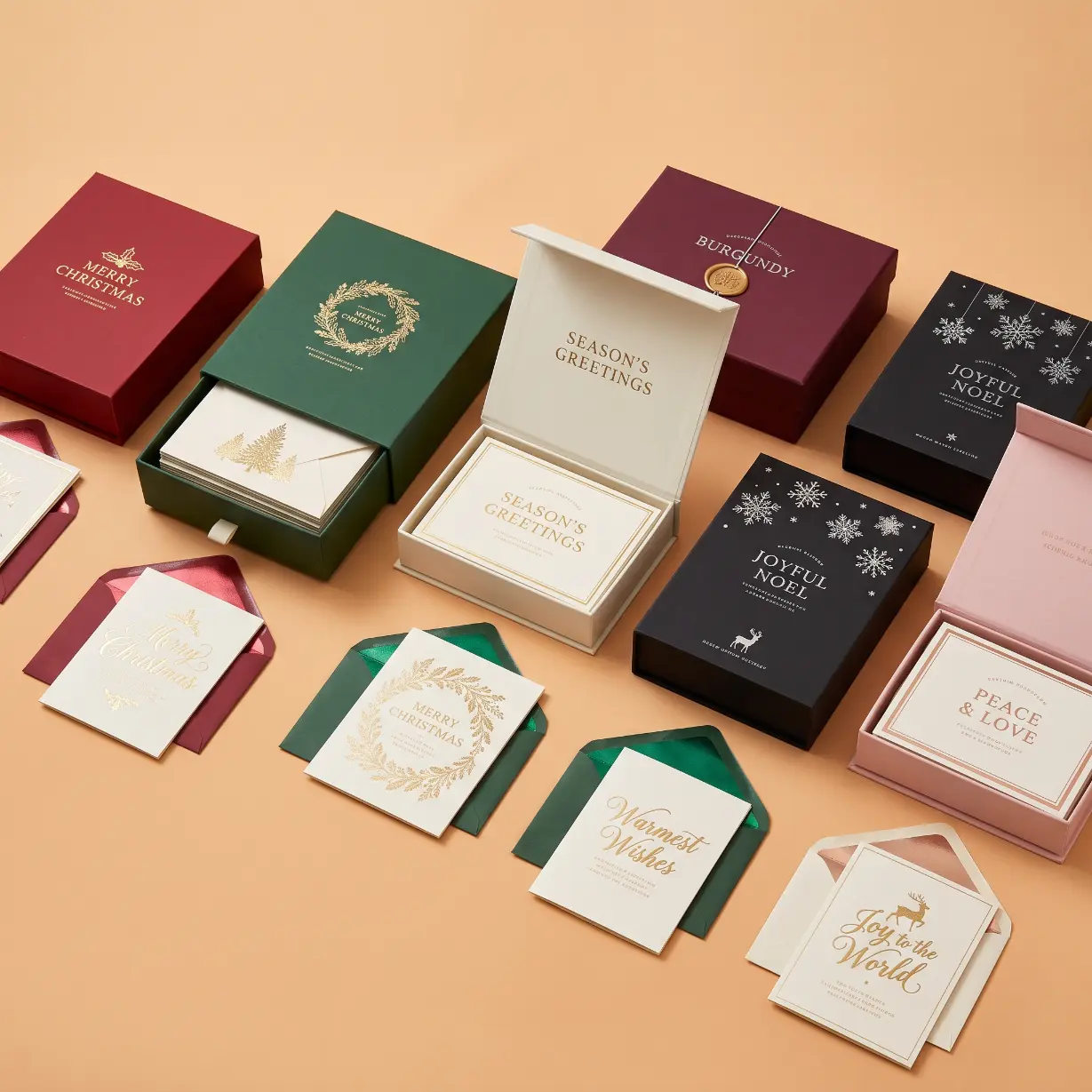
A company, brand, or organization boxing their own custom-printed Christmas cards for distribution to clients, employees, partners, or customers as part of a holiday mailing program. The box is a presentation and gift object that contains the cards and carries the brand.
Both buyer types need a correctly sized box, but the print brief and the commercial purpose of the box are completely different. This page covers both.
The Card Stack Thickness Calculation: How to Size the Box Correctly
This is the specification step most buyers skip, and it is the reason most boxed Christmas card sets have a box that is either too tight (the lid will not close) or too loose (the cards rattle and slide in transit).
The box depth must equal the total stack height of all contents: cards, envelopes, and any divider or insert tissue, plus a minimum clearance that allows the lid to close without pressing on the top card.
The calculation:
- Card thickness: Measure the thickness of one card. For a standard folded A7 Christmas card printed on 130lb cover stock, the folded thickness is approximately 0.5mm per card. Multiply by the card count. For 20 cards at 0.5mm each: 10mm total card stack.
- Envelope thickness: Standard A7 envelopes are approximately 0.1 to 0.15mm each. For 20 envelopes: approximately 2 to 3mm total envelope stack.
- Tissue or liner: If tissue paper or a liner card is included, add its thickness.
- Clearance: Add 3 to 5mm overhead clearance so the lid closes without pressure on the top card.
Total example: 10mm (cards) plus 3mm (envelopes) plus 4mm (clearance) equals 17mm interior box depth for a 20-card A7 set.
Most buyers specify a round number (20mm, 25mm) without doing this calculation and either receive a box that the cards overfill or one where the cards shift freely inside. Calculate from the actual stack, then round up to the nearest millimeter that gives comfortable clearance.
Send us the card count, the card size, the card stock weight, and whether envelopes are included and we calculate the correct interior depth before the dieline is built.
Envelope Inclusion: The Depth and Orientation Decision
Whether envelopes are packed in the box with the cards or shipped separately affects both the interior box depth and the card orientation in the box.
Cards and envelopes together (most common):
Cards and envelopes can be stacked together (card-envelope pairs, each card with its matching envelope stacked directly on top) or separated (all cards in one stack, all envelopes in another stack side by side). The stacked-together approach is more user-friendly but adds the envelope height to every layer of the stack. The separated approach keeps the card and envelope stacks thinner but requires a wider interior to fit both side by side.
For most retail card set boxes (12 to 25 cards), the card-envelope-together stacked approach is standard. The box interior is calculated from the stacked pair thickness multiplied by the count.
Cards only, envelopes in a separate packet:
For corporate mailing programs where envelopes are sourced separately or are not needed (the company uses its own pre-printed branded envelopes), the box depth calculation uses only the card stack. The box is shallower, which can reduce material cost.
Specify clearly when requesting a quote: cards only, or cards with envelopes, and if with envelopes, stacked together or separated.
The Two Box Formats for Christmas Card Sets
Format 1: Tuck-top box with window lid
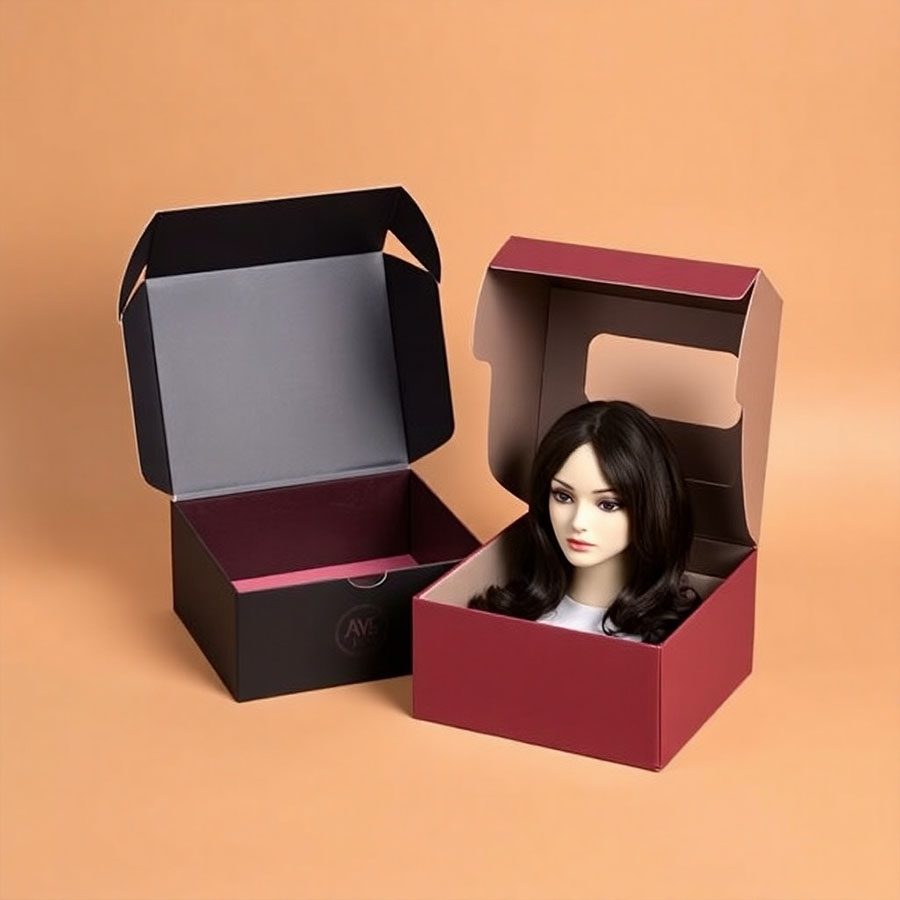
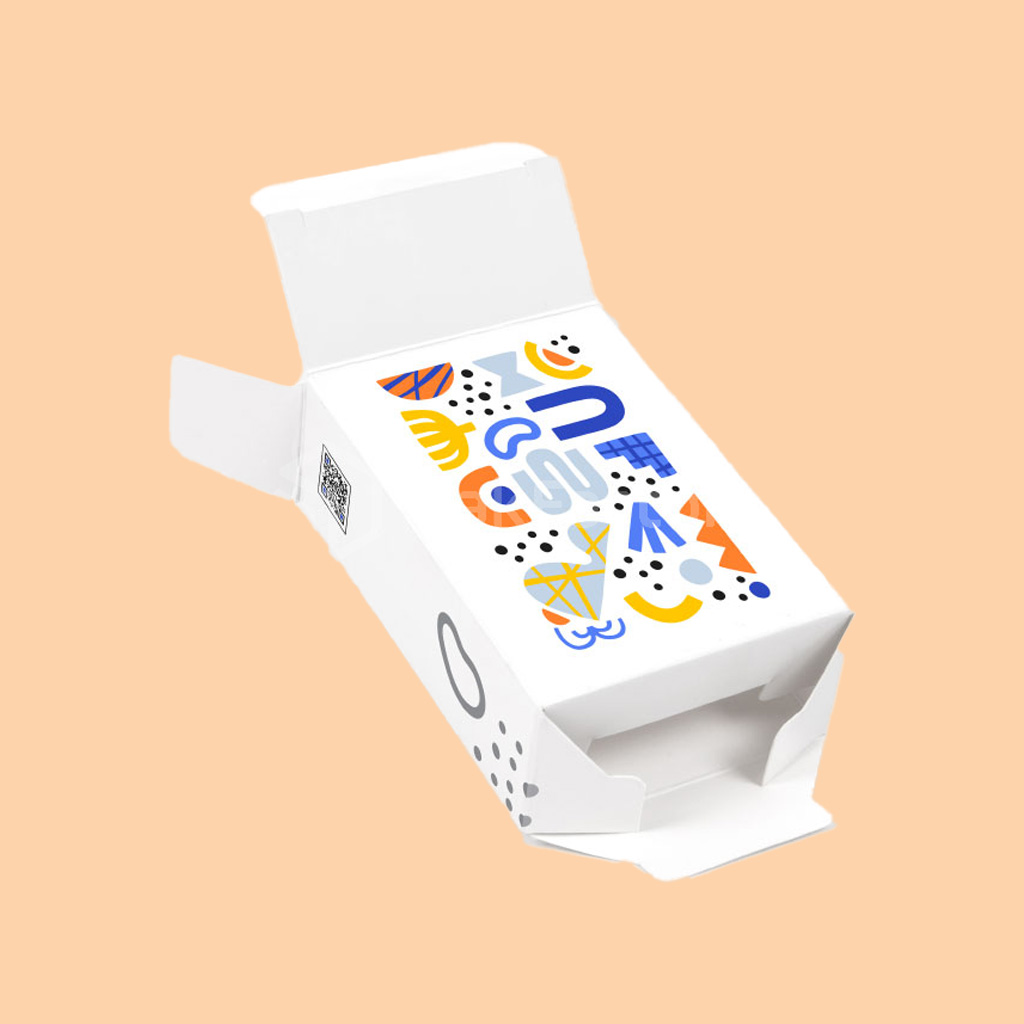
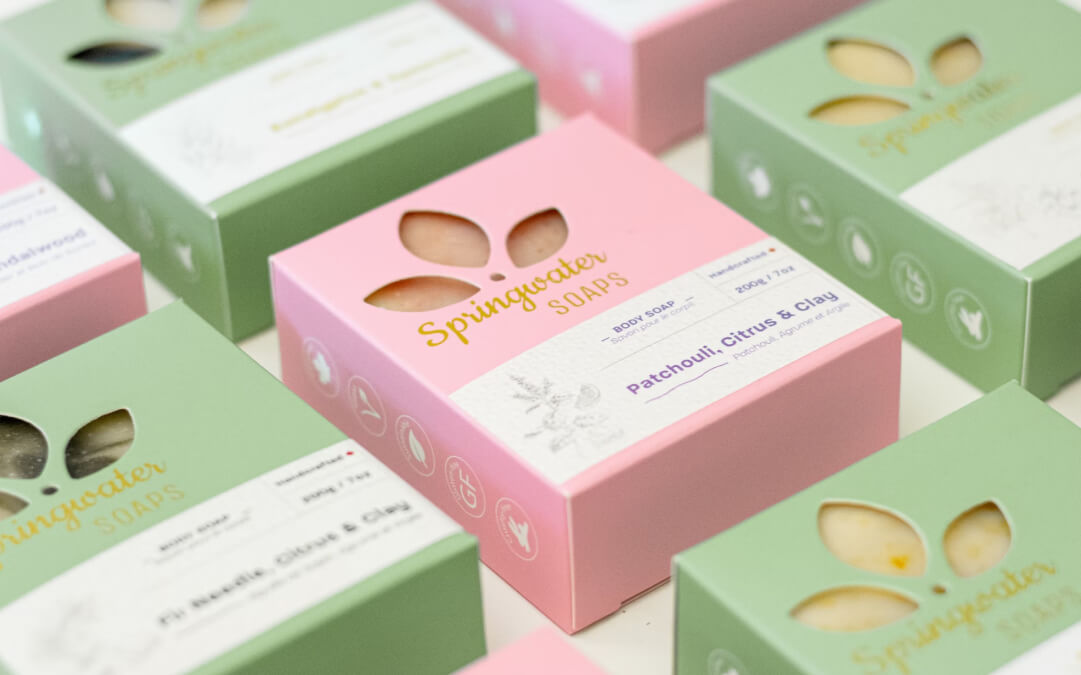
A folding carton with a tuck-in top closure and a clear PET window die-cut into the lid panel. The window shows the top card design through the closed box, which is the primary retail display driver: the customer can see the card artwork before opening the box.
The window is positioned in the center of the lid, sized to show the dominant card design element (typically the Christmas illustration and the greeting) while leaving a frame of printed box surface around the window for the brand or product name.
Best for: retail card set products, gift shop stationery, brand gifting programs where the card design is the hero of the presentation.
Format 2: Lid-and-base (two-piece) box
A separate lid that lifts off the base tray. No tuck flap, no window required (though a window can be added to the lid). The lid-and-base format is more premium in feel than a tuck-top and is appropriate for corporate gifting programs where the box itself is a gift presentation object.
Best for: corporate holiday card gift sets, premium stationery collections, any application where the box is intended to be kept by the recipient after the cards are used.
Standard Christmas Card Sizes and Their Packaging Implications
| Card Size | Folded Dimensions | Envelope Type | Postage Note | Box Interior Width x Length (approx.) |
|---|---|---|---|---|
| A2 | 4.25″ x 5.5″ | A2 envelope | Standard USPS First Class | 4.5″ x 5.75″ interior |
| A6 | 4.5″ x 6.25″ | A6 envelope | Standard USPS First Class | 4.75″ x 6.5″ interior |
| A7 | 5″ x 7″ | A7 envelope | Standard USPS First Class for most weights | 5.25″ x 7.25″ interior |
| 5″ x 5″ square | 5″ x 5″ | Square envelope | Non-machinable surcharge applies | 5.25″ x 5.25″ interior |
| 5.5″ x 8.5″ (half-letter) | 5.5″ x 8.5″ | 6″ x 9″ or catalog envelope | May require additional postage | 5.75″ x 8.75″ interior |
The postage implications matter for retail card sets that are purchased to be mailed: a square card or an oversized card format that triggers a non-machinable surcharge or additional postage will reduce the perceived value of the set to the buyer. Most retail Christmas card sets use A7 (5″ x 7″) as the standard because it fits within First Class letter postage limits.
The Retail Card Set Box: Design Brief
The retail card set box is a shelf product competing against Hallmark, American Greetings, and independent stationery brands. Here is the design brief that makes a retail card set box work at point of sale.
Lid exterior (primary retail surface): Brand name or collection name large, card count (16 cards), the price point or collection descriptor, and the window that shows the card design. The window is the most important element because it allows the customer to evaluate the card before purchase.
Box side panels: Collection name, card count and size information, and any certifications (FSC-certified paper, Made in USA, charity donation note). The information the customer reads after picking up the box.
Base exterior: Additional card design thumbnails if the set includes multiple designs, ingredient list equivalent for stationery (paper weight, print method, envelope color), and any compliance or barcode information.
Interior: Clean white or kraft interior with tissue paper liner for retail presentation. Optional inside lid print with a festive message or brand story.
The Corporate Christmas Card Program Box: Design Brief
The corporate box brief is entirely different from the retail brief. The box is not competing on a retail shelf. It is being given directly to a client, employee, or partner as part of a holiday relationship program.
Box exterior: Company name and logo prominently. A warm but professional seasonal message. The brand’s primary holiday color palette. No price point information, no card count in a sales context.
Optional inside lid: A personal message from the company leadership, a year-in-review highlight, or a charitable giving note. The inside lid is the first thing the recipient reads when the box is opened.
Card arrangement inside: Cards and envelopes organized and presented cleanly, ideally with a ribbon pull or tissue paper separator so the recipient takes the cards out in a deliberate, considered motion rather than reaching in and pulling.
The commercial purpose: The box signals that the company took care with the holiday greeting. A company that sends a well-boxed set of custom-printed Christmas cards communicates more consideration and quality than one that sends cards in a plain envelope or a poly-bag bundle.
Card Count Options and Standard Box Sizes
| Card Count | Interior Dimensions (A7 format, approx.) | Box Depth (card and envelope stack) | Best For |
|---|---|---|---|
| 12 cards | 5.25″ x 7.25″ x 0.9″ | 15 to 18mm | Small gifting sets, premium limited edition, artisan stationery |
| 16 cards | 5.25″ x 7.25″ x 1.1″ | 17 to 22mm | Standard retail gift box, mid-size corporate gift |
| 20 cards | 5.25″ x 7.25″ x 1.3″ | 20 to 25mm | Standard corporate mailing program set |
| 25 cards | 5.25″ x 7.25″ x 1.6″ | 24 to 30mm | Large corporate program, charity fundraiser card set |
| Custom count | Custom | Calculated from stack | Any count to spec |
All depths are approximate and must be confirmed from the actual card and envelope stack before production.
Seasonal Order Deadline for Christmas Card Box Programs
Order by September for November delivery. This timeline allows production plus shipping plus the time your team needs to write, address, and mail the cards before Christmas. Most recipients need to receive cards in the first two weeks of December for the greeting to arrive before the holiday.
For retail card set boxes going into gift shops or retail distribution: order by August or September. Retail buyers typically place holiday stationery orders in September and October, and a product not in stock by October misses the prime selling window.
For corporate programs with large mailing lists: allow additional time for the mailing process. A company sending 500 custom Christmas cards needs time to have cards written and addressed by staff. Build the card-writing and mailing timeline backward from your latest acceptable customer receipt date, then add the box delivery date requirement at the front of that timeline.
Material and Print Options
| Box Format | Material | Best For |
|---|---|---|
| Tuck-top with window | 16 to 18pt SBS white coated | Retail card sets, gift shop display |
| Tuck-top without window | 16 to 18pt SBS or kraft | Corporate gifting, charity programs |
| Lid-and-base (two-piece) | 18 to 20pt SBS or rigid greyboard | Premium corporate gift, keepsake box |
| Kraft tuck-top | Kraft (uncoated) | Eco-forward, artisan, natural brands |
Print finishes: PMS spot-color for holiday palette accuracy, full CMYK for multi-color seasonal illustration, foil stamping for gold or silver holiday accents, soft-touch matte for premium corporate feel, gloss lamination for retail shelf impact.
Packaging Expert Tip: Test the Stack Before Approving the Depth
Here is the quality check that prevents the most common boxed Christmas card production problem, and that no competitor addresses.
Before approving the box dimensions, stack the actual cards and envelopes in the exact configuration they will be packed. Place them in a test enclosure cut to the proposed interior depth. Close the lid.
Two checks:
First: does the lid close completely without pressing on the top card? If the lid presses on the card, the stack is too tall for the interior depth. Increase the box depth by 3 to 5mm or reduce the card count.
Second: with the lid closed, turn the box on its side and shake gently. Do the cards move significantly inside the box? If they rattle or shift by more than a few millimeters, the interior is too large. Add a spacer card or tissue layer to fill the excess depth, or reduce the interior depth.
A box that is too tight marks the top card with the lid impression. A box that is too loose allows the cards to shuffle and the top card to arrive face-down and disordered. The test stack check, done with actual cards and envelopes, prevents both.
What Every Hexa Order Includes
These terms apply to every order without exception or fine print:
- No die charges and no plate charges, zero hidden setup fees
- Low 100-box minimum for test runs or full production
- 8 to 10 business day turnaround from approved artwork
- Free dielines and ready-to-use templates
- Free 24/7 structural and print support from real packaging people
- 100% recyclable board stock on every order
Order by September for pre-Christmas delivery. Holiday packaging production slots fill earlier than most buyers expect.
A Box That Presents the Cards, Carries the Brand, and Arrives Before December.
Card stack depth calculated. Window positioned on the top card design. Envelopes included and organized. Order by September for comfortable pre-Christmas delivery.
Get your free quote today. No setup fees, low 100-box minimum, delivered in 8 to 10 business days.
- 👉 Request a Free Quote
- 📞 Talk to a packaging expert — free 24/7 support
- ✉️ Email us anytime: hello@hexacustomboxes.com