














Description
Custom 24 Days Advent Calendar Boxes 2026: The Format That Owns December
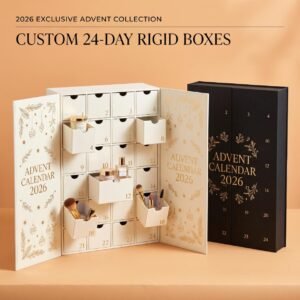
Twenty-four doors. Twenty-four days. One product sitting on your customer’s desk, mantel, or shelf from December 1 to December 24, opened every single morning before anything else happens.
No other piece of packaging delivers 24 consecutive daily interactions with a willing, engaged customer. No paid media channel, no email sequence, no social campaign comes close to the sustained attention of a physical countdown box your customer chose to buy and looks forward to opening every day.
The 24-day advent calendar has become, as one industry analysis put it, infrastructure for entirely different commercial objectives: customer retention, product discovery, limited-edition positioning, and premium gifting all wrapped in one familiar format. Brands across beauty, food, spirits, wellness, and corporate gifting have built entire seasonal campaigns around it.
Custom 24 days advent calendar boxes from Hexa Custom Boxes are built for 2026 brands that want the format working at its full commercial potential, not just checking a holiday packaging box.
December 2026: The Calendar That Shapes Your Deadline
December 1, 2026 falls on a Tuesday. That single date determines every production, shipping, and delivery deadline in the planning chain.
| Milestone | Date for December 1, 2026 Delivery |
|---|---|
| Physical sample approval (if needed) | By August 1, 2026 |
| Artwork and spec finalized | By August 15, 2026 |
| Order placed | By end of August 2026 |
| Production complete | October 2026 |
| Delivery to brand or fulfillment partner | By November 1, 2026 |
| Shipped to end customer (retail or DTC) | By November 20, 2026 at latest |
| Available to open: Day 1 | December 1, 2026 |
December 1 being a Tuesday means your customer needs the box before December 1. That means your fulfillment partner needs it before November 20. That means production needs to be complete in October. That means the order needs to be placed by the end of August at the latest.
If you are reading this before August 2026, you are in the planning window. Contact us now and we will lock in your spec and timeline before production slots fill for the 2026 holiday season.
24 Days vs 25 Days: The Format Decision Nobody Explains
Every supplier lists both. Nobody explains the difference clearly.
| Format | Countdown Window | Christmas Day | Best For |
|---|---|---|---|
| 24-day (this format) | December 1 to 24 | Not included, last door is Christmas Eve | The standard. Builds to Christmas Day without including it. Classic format customers recognize. |
| 25-day | December 1 to 25 | Included as Day 25, often the hero reveal | Brands with a strong hero product to reveal on Christmas Day. Adds cost and one more cell. |
For most brands, 24 days is the right choice. Christmas Eve as the final door creates a satisfying close without requiring a 25th product of sufficient weight to justify the extra day. Choose 25 only when you have something genuinely special to put behind Door 25 that earns the extension.
Grid Layout: How 24 Cells Are Arranged on the Front Panel
This is the design decision that determines how the calendar looks on display and how intuitive it is for the customer to find each numbered door. No supplier explains this.
24 cells can be arranged several ways, and each signals something different.
| Grid Layout | Cell Arrangement | What It Signals |
|---|---|---|
| 4 columns x 6 rows | Standard grid, even rows and columns | Classic, organized, easy to navigate, most common |
| 6 columns x 4 rows | Wider than tall, landscape orientation | Works for products that are wider than they are tall |
| 3 columns x 8 rows | Taller than wide, portrait orientation | Works for skinny, tall cells like lipstick or vials |
| Asymmetric mixed grid | Varied cell sizes across the front | Premium, editorial look, hides which day is which size |
| Curved or shaped layout | Cells arranged in a tree, arch, or star shape | Decorative, seasonal display piece, less intuitive to navigate |
For most brands, a 4×6 or 6×4 uniform grid is the right choice. It is easy for the customer to find any given day, visually satisfying as doors open across the month, and cost-efficient to produce.
Asymmetric mixed grids work well for brands that want to hide cell size variation (so customers cannot tell which days hold the bigger items just by looking at the door size). The trade-off is a more complex dieline and a higher production cost.
The Curation Pacing Problem and How to Solve It
This is the most common reason a 24-door calendar underperforms, and no packaging supplier names it.
The filler day problem: brands concentrate the best items on Days 1, 12, and 24 and fill the middle with products that feel like padding. Customers notice by Day 8. Social media commentary about “disappointing days” appears by Day 10. The engagement the calendar was supposed to build starts eroding instead.
The fix is pacing, not just curation. Here is the structure that keeps all 24 days feeling intentional.
Days 1 to 7 (Week 1): Open strong. Day 1 is the purchase justification moment. Put something genuinely good there. Maintain quality through Week 1 because this is when customers film and share the most.
Days 8 to 15 (Week 2): Introduce variety. If the first week leaned beauty, introduce a complementary category. If the first week was all samples, include one full size. The variety is what keeps customers opening on the days they would otherwise skip.
Days 16 to 22 (Week 3 and into Week 4): Build anticipation. Items can be slightly smaller in size but should increase in perceived value, a limited edition, a seasonal exclusive, a personalized element. The customer should feel momentum toward the close.
Day 23 and 24: The close. Day 23 can be a preview or a pairing for Day 24. Day 24 (Christmas Eve) should be the strongest item or a meaningful combined element that ties the 24-day story together.
This structure ensures no day feels like filler because each week has a defined role in the customer’s experience arc.
Cell Sizing Guide for 24-Door Formats
24-door calendars typically hold smaller, lighter products than 12-door formats because the total curation count is higher and the per-unit cost needs to stay manageable. Here is a practical sizing guide.
| Product Type | Typical Cell Interior Size | Notes |
|---|---|---|
| Chocolate squares and confectionery | 40mm x 40mm x 15mm | Standard mass-market calendar size |
| Candy, gummy, single-serve sweets | 50mm x 45mm x 20mm | Allow for bag or wrapper |
| Skincare sachet or sample packet | 70mm x 50mm x 12mm | Flat pack, food-safe SBS |
| Mini lipstick or lip balm | 25mm x 25mm x 70mm | Tall narrow cell |
| Mini mascara or eyeliner | 20mm x 20mm x 110mm | Confirm product height |
| Nail polish bottle (mini) | 30mm x 30mm x 60mm | Upright cell, check diameter |
| Tea bag or single-serve coffee | 80mm x 60mm x 10mm | Flat, lightweight |
| Single-use skincare sheet mask | 90mm x 130mm x 5mm | Flat folded, wider cell |
| Small candle tin (travel size) | 60mm x 60mm x 35mm | Check weight per cell |
| Jewelry (single earring or ring) | 55mm x 55mm x 25mm | Foam pad recommended |
Mixed-size cells are available for calendars where the 24 items vary in size. The asymmetric grid layout works best when cell sizes vary significantly across the front panel.
Inside-Door Print Strategy for a 24-Door Calendar
Twenty-four inside-door panels are twenty-four daily brand messages to a customer who chose to engage with your brand every morning for a month. Here is how to brief them so they work.
The consistency principle: The inside-door design should have a consistent visual template across all 24 panels so the opening experience feels like a unified brand world, not 24 different afterthoughts. A consistent color background, font, and layout with the day number prominent and the day’s content below it.
What goes on each panel:
- Product context: A short line about what the day’s item is and how to use it. Not a feature list, one useful sentence. “Use this serum for three nights in a row and you will understand why it sells out every year.”
- QR code: Links to a tutorial, a recipe, a product page with a reorder link, or a brand story video. Variable data printing allows each door to carry a unique QR code with unique UTM parameters so you can track which doors drive the most clicks.
- Day-specific promo code: A discount code valid only on that day. Creates urgency, drives direct purchase, and gives you redemption data on which day in December converts best.
- Brand narrative chapter: A 24-chapter brand story told one panel at a time, resolving on Christmas Eve. Works best for heritage brands with a genuine story to tell.
Brief the inside-door panels before you brief the exterior artwork. The interior is what the customer sees every day. The exterior is what sells the calendar before it is opened.
Social Media and the Unboxing Design Brief
A 24-day advent calendar generates more organic social content than almost any other product category. Customers film the daily open, post the reveal, and tag the brand. Here is how to design the box to earn that content.
The numbered door face: The number should be large enough to read in a short-form video frame from a hand-held camera. Emboss or Spot UV the number so it has tactile contrast that reads well on camera.
The product reveal moment: The cell behind the door should present the product upright and visible the instant the door opens. A die-cut foam pad or a molded insert holds the product in a presented position rather than lying flat. The camera captures the product before the customer touches it.
The front panel visual: When all 24 doors are closed, the front panel is a complete piece of artwork. Design it as a coherent visual that becomes progressively revealed as doors open across the month. By December 24 the customer has assembled the full picture one door at a time.
The hashtag or handle: Print it on the inside of Door 1 so the customer sees it on the first day and knows how to tag the brand from the start of the countdown.
Structure and Material Options for 24-Door Formats
| Structure | How It Works | Best For |
|---|---|---|
| Perforated tear-open flap | Numbered flap tears along perforation to reveal cell | Mass-market, confectionery, beauty samples, most standard formats |
| Magnetic re-closeable door | Small magnetized panel opens and reclosures each day | Mid-premium, display formats, anything meant to sit on the mantel |
| Pull-out drawer | Individual cell slides out from front panel | Premium gifting, jewelry, high-value beauty, corporate formats |
| Hybrid rigid-paperboard | Paperboard body with a rigid cover or magnetic lid | Cost-effective premium look, DTC and retail both |
| Material | Best For |
|---|---|
| 350gsm SBS | Most standard retail beauty, food, and confectionery formats |
| Kraft paperboard | Artisan food, eco-forward, organic, and natural brands |
| E-flute corrugated | Heavier products per cell, shipping-forward formats |
| Rigid greyboard (2mm) | Premium beauty, jewelry, corporate gifting, luxury positioning |
Packaging Expert Tip: Design the Box as a Limited-Edition Object, Not a Container
Here is the framing shift that separates a calendar that sells out from one that sits on the shelf.
The most commercially successful 24-day advent calendars treat the box itself as a limited-edition collectible. The packaging is part of the product value, not a vehicle for it. Customers who feel the box is worth keeping display it during December, which generates passive brand impressions in every room it sits in. Customers who share the unboxing on social generate content that sells the next year’s calendar before it is even announced.
Two design moves that create this effect. First, make the exterior artwork season-specific and year-stamped. A calendar with “2026” visibly incorporated into the design signals that this is a collectible, not a generic product. The year stamp also drives urgency because the customer knows this edition only exists this year.
Second, use the exterior front panel as the full-bleed artwork canvas it is. Do not tile the logo and repeat a pattern. Commission an original illustration or a seasonal motif that only exists on this box, in this year’s colorway. The editorial calendar brands do this and sell out in hours. The generic ones do not.
Brief the packaging designer before briefing the product team. The box is the first product the customer interacts with. It deserves the same creative investment as what goes inside it.
What Every Hexa Order Includes
These terms apply to every order without exception or fine print:
- No die charges and no plate charges, zero hidden setup fees
- Low 100-box minimum for test runs or full seasonal production
- Free dielines and ready-to-use templates
- Free 24/7 structural and print support from real packaging people
- 100% recyclable board stock on every order
Note on turnaround: Advent calendar boxes require longer production windows than standard folding cartons. See the 2026 planning timeline at the top of this page for the specific dates that determine whether your calendar reaches customers before December 1.
Twenty-Four Days. One Box. The Most Engaged Your Customers Will Be All Year.
A custom 24 days advent calendar for 2026 delivers what no other marketing format can: a daily physical interaction with a willing customer from December 1 to Christmas Eve. Brief it like a limited-edition product. Order it like a December 1 deadline. The planning window is open now.
Get your free quote today. Low 100-box minimum, no setup fees. Order by August 2026 for December 1 delivery.
- 👉 Request a Free Quote
- 📞 Talk to a packaging expert — free 24/7 support
- ✉️ Email us anytime: hello@hexacustomboxes.com